What Woodpeckers Are Visiting Your Yard?
Jerry Logan from eastside, wrote an email asking "What are the most common types of woodpeckers I'm likely to see in my yard?"
Now, let's take a closer look at them so we know how to identify each when we see them.
Woodpeckers, named for just that - they peck wood, have chacteristics that are different from other bird species.
They can be identified by stout sharply-pointed beaks, stiff tail feathers, and short legs that are equipped with four sharp clawed toes (two toes face forward and two backwards).
In late fall and into winter these birds really seem to appear. Although always around, it just seems they hide better in summer than winter.
Visiting feeders and circling trees, these birds seem to come alive in colder weather.
They are members of the Picidae family which includes Flickers and Sapsuckers. About 45 are found in North America.
You can get more detailed information about identifying and attracting the common types in your yard by following the different links below.
What Types Are You Likely to See?
Let's Begin
Downy Woodpecker
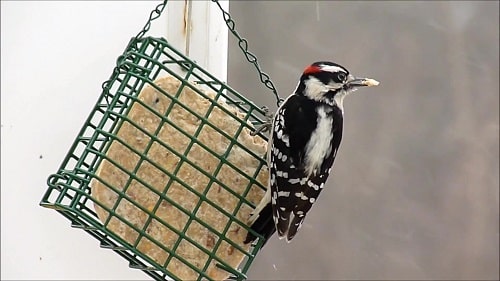
Our smallest woodpecker the Downy is only about 6 - 7 inches in length and loves suet and sunflower seed at feeders.
Sometimes uses man-made birdhouses but if a tree cavity can be had, it will likely use that for nesting. more about the Downy...
Hairy Woodpecker
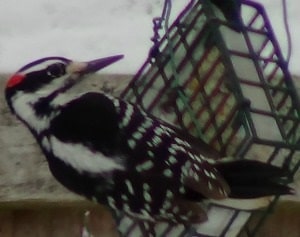
The Hairy woodpecker looks like a larger version of the Downy.
The Hairy has a bill that is as long as its head and the bird is is 9 - 10 inches long.
Suet and Black-oil Sunflower seeds will keep this bird coming back. more about the Hairy Woodpecker...
Northern Flicker
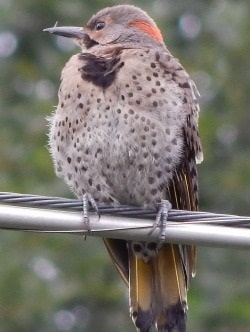
The Northern Flicker is found throughout North America and has 5 subspecies. In the East and North, it's the Yellow-shafted Flicker.
In the West, lives the Red-shafted. In the deserts of S.E. California and southern Arizona it is the Gilded Flicker.
Ants make up 45 percent of their diet. Berries and seeds are favorites. more about the Flicker...
Pileated Woodpecker
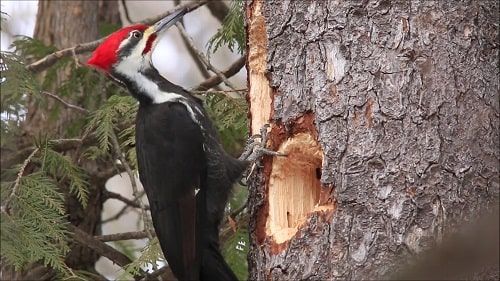
North Americas most giant woodpecker, the Pileated, is 16 - 19 inches in length and has a wingspan of up to 30 inches.
Such a large bird inhabits an area as large as 150 - 200 acres. Eating carpenter ants and berries.
If they are in your neighborhood a suet feeder will draw them in. more about the Pileated...
Red-headed Woodpecker
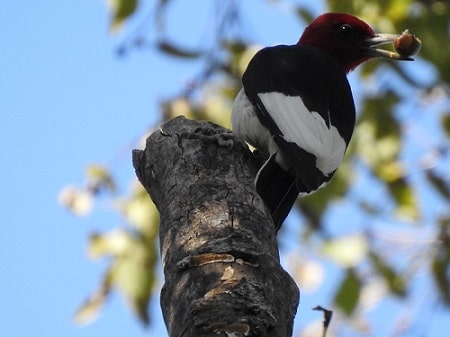
The Red-headed Woodpecker is the model for Woody Woodpecker if you're old enough to remember the cartoon figure.
The only type of woodpecker to have a full red head and not just red on the top or nape.
The striking white and black wings make it easy to identify in flight.
These guys will catch insects in flight and cache nuts and seeds in small cavities. more about the Red-Headed...
Red-bellied Woodpecker
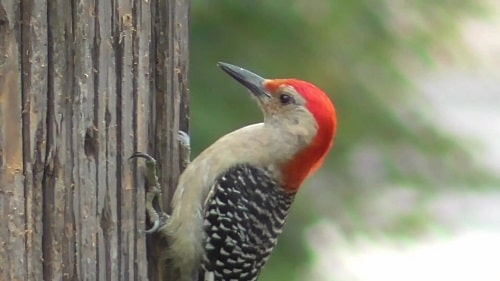
The Red-bellied Woodpecker almost seems to be misnamed as it's not always easy to see the small patch of red on the belly that it's named for.
The Red-bellied sometimes uses man-made bird houses and in summer will come to oranges cut in half to eat.
In winter, peanut butter, suet, sunflower seed, and cracked corn will bring them to your feeders. more about the Red-bellied...
Nesting Habits
Woodpeckers are usually found in woodland areas; however, these birds can be found in treeless areas where utility poles and wood-sided houses and other structures provide suitable substitutes for trees.
Easily excavating holes in dead tree limbs for nesting and raising young.
The front and rear toes along with their stiff tail feathers make these birds uniquely adapted to drilling holes in wood for nesting.
As cavity nesters, some of these birds are good candidates for man-made bird houses.
What do Woodpeckers Eat?
Woodpeckers are beneficial because of the large numbers of insect pests they eat.
Depending on type, they eat many wood-boring insects, spiders, caterpillars, berries, and seeds.
The Pileated primarily feeds on ants, although it will also eat wood-boring insects and berries.
Woodpeckers do not eat wood. Instead, they are searching for insects beneath the bark of trees and even termites behind siding.
Why Woodpeckers Peck - Drumming
Woodpecker Drumming is defined as: rapidly pecking on wood, metal, or any resonate surface. The purpose is twofold.
One is to announce territory so that others, primarily males, stay away.
The other reason for drumming is to attract a mate. Females hear the sound and check the male and his territory out.
If she likes all that she sees, she'll choose him as her mate and begin nesting.
Attracting and Nesting
You can often attract these birds to your yard by offering suet and black oil sunflower seed.
Downy and Hairy Woodpeckers, along with Northern Flickers, are especially attracted to suet.
wild-bird-watching.com participates in Amazon.com associates program. As such, we earn commisions from qualifying sales at no additional cost to you. See our Privacy Policy Here
Some of these birds will use man made bird houses. These include the Hairy, Red-bellied, Red-headed, and Flicker.
If you have any of these in your area you might want to try placing a bird house for them.
Females will lay a clutch of 4 to 8 white eggs in an excavated tree cavity or bird house. Both adults generally assist with incubation and feeding of the young.
Migration
Classified as nongame migratory birds, these birds are protected by the 1918 Migratory Bird Treaty Act and state wildlife laws.
Before any person may take, possess, or transport any migratory bird or its parts including feathers, eggs, nest, ect., they must secure a permit issued by the U.S. Fish and Wildlife Service.
Although they are considered migratory, many do not travel long distances. Many are year-long residents of the states they are found.
Damage aAnd Control
Damage typically occurs during spring and fall. In the spring when pairs are actively looking for nesting cavities, cedar wood sided houses can be damaged.
Certain types of bees and other insects use the grooves in board and batten siding to lay eggs which attract the bird pairs.
Controlling Damage
The best way to control damage caused by woodpeckers is to start when the damage first occurs.
Once they establish a feeding or nesting territory, it becomes much more difficult to manage.
If there are any cracks or opening that attract them or provide a surface for them to cling to, these should be repaired. In some cases this may be all that is needed.
Some steps you can take that may help are: stretching plastic tightly over the area. If the area is small, placing flashing of metal over the areaa.
By law, no one can capture or harm these birds without written permission from federal and state wildlife agencies.
For the most part, woodpecker damage is minimal. There are sensor activated water devices also available.
These spray water when the birds break a beam of light in the sensors path.
It is Illegal to Harm Woodpeckers
All Woodpeckers are protected under the Migratory Bird Treaty Act, state law, and even local city ordinances.
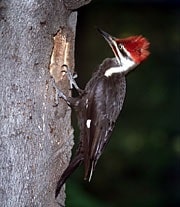
Not only is is illegal to harm woodpeckers but also to be in possession of the birds, their eggs, and even feathers.
You May Also Like:
How Woodpeckers Make Their Nest

Fledging is happening Now! Keep cats indoors and stay with your dogs when outside.
Fledgling birds may be on the ground. The adults continue caring for their young for a week or two after they leave the nest.
"What an awesome website. My little one and I enjoy playing the different bird calls and watching some of the videos — thank you!"
– Linda B., Illinois