Hairy Woodpecker: ID Tips, Nesting Timeline & Feeding Habits
Description: Size, Field Marks
The Hairy Woodpecker is very similar to the Downy in appearance. A white back and white underparts and black wings with white spots.
And like the Downy, males have the same red on the back of the nape. While the females have no red.
The difference is their size. The Hairy is about 2 inches longer.
Measuring about 8.5 to 10 inches in length. The bird's bill is almost as long as the head whereas, the Downy's bill is only about half as long as its head.
The upper parts are black and white, the face is black and white stripes and the underparts are pure white.
Males have a red patch at the nape of the neck, the females lack a red patch.
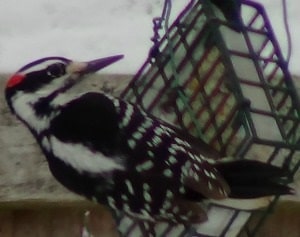
These birds prefer a habitat of mature forests, orchards, and parks. They are one of the most widespread North American birds.
Hairy Woodpecker Sounds: Sharp "Peeps" + Brief Drumming
What you're hearing: This clip features several sharp, high "peep" notes, one of the common contact calls a Hairy Woodpecker gives while moving through trees.
At the end, there's a very short burst of drumming (rapid tapping on wood), which woodpeckers use to communicate during territory and courtship season.
The calls are used by the birds to keep in touch as they forage, while drumming is more like a long-distance "announcement."
Mating Season and Courtship Behavior
While the peak of the breeding season is in April and May, and nesting may go into July, courtship begins much earlier.
These birds have a slow courtship that begins in deep winter.
The males begin drumming on a favorite post to announce that he has set up his territory.
The drumming aims to attract a mate and let other males know he is there and for them to stay out.
An interested female will drum back to announce her presence.
When the two woodpeckers approach one another, usually after days or weeks of drumming, they perform special flight displays.
The birds will strike their wings against their sides to produce a clapping sound, or flutter their wings like butterflies, seeming to almost hover in the air.
After the pair bond is formed, the two breed and begin nesting.
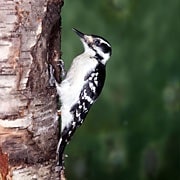
During the breeding season, you'll find these birds in heavily forested areas.
They can also be found in heavily wooded residential areas and cemeteries that have many mature trees.
Nesting Habits: Eggs, Incubation, Fledging
Hairy Woodpeckers excavate a cavity in a tree anywhere from 3 to 55 feet above the ground. This process can take 1 - 3 weeks.
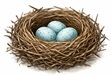
The female lays from 3 to 6 white eggs laid on a bed of wood chips.
Both males and females incubate the eggs and share the brooding of the young.
The male sits on the eggs and broods the young during the night, and the female relieves him every morning after sunrise. They alternate these duties throughout the day.
Table Showing Nesting Cycle Timeline
| Nesting Stage | Typical Timing or Number |
|---|---|
| Eggs per clutch | 3 - 6 |
| Incubation Period | 11 - 12 days |
| Nestling Phase | 28 - 30 days |
| Broods per season | 1 |
Incubation lasts about 11-12 days and the young leave the nest about 28-30 days after hatching.
Will make use of properly constructed birdhouses
The nest is excavated in either dead snags or live trees, provided there is heartrot in the live tree.
Habitat size requirements can vary depending on the type of habitat available.
Dense areas will hold more bird pairs than more open areas.
Feeding Habits What They Eat
Hairy Woodpeckers feed mostly on insects they find in tree bark and wood. Their main foods include wood-boring beetle larvae, bark beetles, ants, caterpillars, and other small insects hidden in bark crevices.
Although insects make up most of their diet, Hairy Woodpeckers also eat berries, seeds, nuts, and sometimes sap from damaged trees or old sapsucker wells.
At backyard feeders, they are most likely to visit for suet, sunflower seeds, and peanuts, especially during colder months when insects are harder to find.
Predators
Predators of adult birds include Great-horned Owls, Eastern Screech Owls, Barred Owls, Northern Goshawks, Sharp-shinned, and Cooper's Hawks.
Predators at the nest site include House Sparrows, European Starlings, and Red-bellied Woodpeckers. Rat snakes prey on eggs and young.

Gene Planker is the creator of Wild-Bird-Watching.com, where he shares over 50 years of backyard birding experience. His guides help readers understand the nesting, feeding, and behavior of backyard birds.
 Readers Digest Guide
|
 Golden Guide
|
 Your State Only
|
 Nat-Geo Guide
|


Before trimming shrubs or mowing, check for active nests. Many birds begin nesting earlier than expected, and a quick look can prevent accidentally disturbing a brood.

"What an awesome website. My little one and I enjoy playing the different bird calls and watching some of the videos, thank you!"
– Linda B., Illinois