Discover the Pileated Woodpecker Mating, Nesting, Feeding Habits
This guide covers the nesting habits, mating rituals, diet, breeding season, and more.
Pileated Woodpecker: Size and Field Marks
Pileated woodpeckers are large, crow-sized woodpeckers with striking black and white plumage. The Ivory-billed Woodpecker was larger but sadly, is extinct.
They have a prominent red crest on their head, which extends from the bill to the nape of the neck, and a white stripe that runs down the sides of their neck.
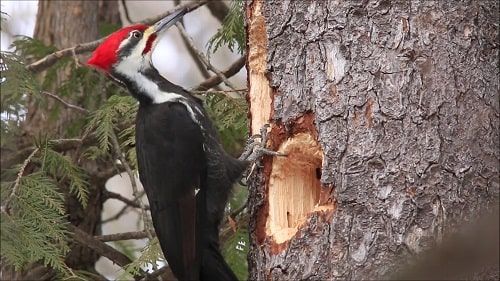
The red crest is why they are called pileated. The Latin word pileatus, which translates to "capped" is a reference to the crest.
Their body is mostly black, except for white markings on the wings and a white patch on the throat.
Pileated woodpeckers have a powerful bill that is long and chisel-shaped, which they use to chip away at tree bark to access insects or to excavate nesting cavities in dead or dying trees.
Their feet are zygodactyl, which means they have two toes facing forward and two toes facing backward, allowing them to grip tree trunks and branches with great strength and maneuverability.
Males and females look very similar, but males have a red stripe on their cheeks, while females do not.
Juvenile pileated woodpeckers have a shorter crest and less vivid plumage than adults.
Pileated Woodpeckers measure 16 to 19 inches long with a red crest and black bill. You'll find these birds living in a mature forest with large trees.
The male Pileated has a red patch at the base of the bill whereas the female has a black patch at the base of the bill.
An adult male can have a wingspan of 30 inches.
Feeding Habits - Diet of Pileated Woodpeckers
The Pileated Woodpeckers' diet in the wild is made up of Carpenter ants and beetle larvae. They also eat berries and nuts.
While going after carpenter ants, the Pileated will leave long gashes along the tree. They typically find these insects in decaying trees and logs.
With its sticky, barbed, long tongue, the bird can reach the insects deep inside the decaying wood.
Do Pileated Woodpeckers Mate for Life? Mating Rituals
By observing Pileated Woodpeckers, you may witness them performing a courtship dance.
This dance consists of one bird bowing, scraping, and stepping sideways in a circle around another bird.
Pileated Woodpeckers mate for life, pairs will stay together throughout the year. During Fall and Winter, the pairs roost and sleep at different locations during the night.
Males sometimes use the previous nest site as their nighttime roost.
When is the Mating and Breeding Season of Pileated Woodpeckers?
The breeding/mating season for the pileated woodpecker typically varies based on their geographic location. In general, it falls within the spring and early summer months.
In the northern parts of their range (such as Canada and the northern United States), the breeding season can start as early as March or April and extend through May or June.
In more southern regions (southern United States), the breeding season may start earlier, around February or March, and continue through April or May.
Keep in mind that Woodpeckers, like many other bird species, tend to breed during the time of year when food is abundant and the weather is favorable for nesting and raising their young.
Nesting Habits
Nest Location
Pileated Woodpeckers prefer dense, mature forests for nesting. The nest cavity is excavated in a dead or decaying tree 15 to 70 feet above the ground.
The Pileated's territory can be 150-200 acres. You can detect signs of their presence by looking for 3-6 inch holes in trees.
Offering suet will bring them to your yard for a close-up look.
Males select the nest site, but both males and females will take part in the excavation with males doing most of the excavation.
Nest Size
An entrance hole of 3 1/2 inches in diameter will be hammered out. The depth of the cavity is between 10-24 inches deep.
These large cavities may be used by Boreal Owls and Wood Ducks in future seasons.
Territories are defended throughout the year with some allowance for floaters to pass through.
Egg Laying and Incubation
The female will lay 3-5 white eggs with 4 eggs being the most common.
Both males and females will incubate the eggs (the gestation period is not the correct term for birds) for 15 - 16 days.
Both males and females will also feed the nestlings. The young will be in the nest for 24 - 28 days.
| Pileated Woodpecker Nesting Stats | |
|---|---|
| Eggs | 3 - 5 |
| Incubation | 15 - 16 days |
| Nestling Phase | 24 - 28 days |
| Broods | 1 |
After Young Leave Nest (fledge)
Once the young fledge, the adults and juvenile Pileated Woodpeckers will stay together until fall.
The adults will continue to feed and teach survival skills during this phase.
Around September, the family will break up and the young will find territories of their own.
Only one brood is raised each season, but second attempts may happen if predators attack the first brood. Sometimes in the same cavity.
Pileated Woodpeckers build A new nest site each season and do not reuse nesting sites for raising young. They will use old nest sites for roosting/sleeping.

Calls Drumming: Meanings and Purpose
The pileated woodpecker has a distinctive call that is often described as a loud, high-pitched, and resonant "kuk-kuk-kuk" or "wick-a-wick-a-wick" sound.
It can also produce a series of rapid drumming sounds on trees, which can be quite loud and carry over long distances.
The calls and drumming of the pileated woodpecker are often used for territorial communication and attracting mates.
What are the Pileated Woodpeckers Predators?
Common predators include Black snakes, Coopers Hawks, Northern Goshawks, Red-tailed Hawk, Great Horned Owl, and Squirrels.
While pairs remain together for life, when one dies, the other will not abandon the territory. They will drum and call to attract a new mate from an adjacent territory.
While not rare birds, they can be quite shy. Listen for low-pitched drumming that trails off in speed and volume at the end.
Follow the sound, and you just may find one.
You May Also Like: How Woodpeckers Make Their Nest
Pileated Videos - Feeding Young Searchin for Food
Video Submitted by Lamar
This video was taken in my backyard in a sycamore tree. I spent about 3 hours in the tree to get this video of A Pileated Woodpecker feeding its babies.
I hope everyone enjoys this video as much as I have. THANK YOU: Lamar
Kevin from Florida shares this video with us. Filmed in Sumter County Florida using Sony HDR-SR11 camera.

Gene Planker is the creator of Wild-Bird-Watching.com, where he shares over 50 years of backyard birding experience. His guides help readers understand the nesting, feeding, and behavior of backyard birds.
Entities & Sources
- Pileated Woodpecker (Dryocopus pileatus)
- Picidae (family)
- Videos curated from YouTube
- Home Range and Habitat (Auto Download PDF File)




Add evergreen cover or place roosting boxes near feeders.
Birds will use them to escape wind and snow.
A simple way to help them survive harsh nights.
"What an awesome website. My little one and I enjoy playing the different bird calls and watching some of the videos, thank you!"
– Linda B., Illinois