Why Do Gray Squirrels Strip Bark From Trees?
It may look destructive at first, but this is often part of nest building.
Gray squirrels are best known for building leaf nests, also called dreys, high in the branches.
From the ground, those nests can look like loose balls of leaves and twigs, but they are often more carefully put together than they seem.
Along with twigs, leaves, and softer lining materials, squirrels sometimes use long strips of fresh bark to help strengthen parts of the nest.
The bark is flexible when fresh, easy to carry when folded into a compact bundle, and firm enough to help hold materials together once it dries.
Why do gray squirrels strip bark from trees?
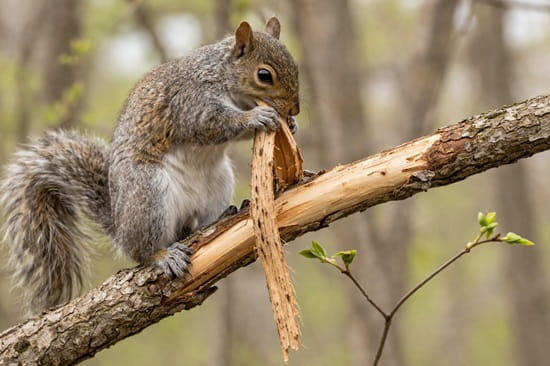
If you see bark peeled from thin branches in long, narrow strips, there is a good chance a gray squirrel is responsible.
They are not usually after the rough outer bark on large trunks. More often, they take bark from younger branches where it peels more easily in spring.
This behavior is most likely tied to nest construction or nest repair. A squirrel carrying bark away in long folded strips is usually gathering material, not just chewing at the branch.
The folding behavior is one of the most noticeable parts. Instead of dragging a long strip behind them, squirrels bunch it into a compact wad in their mouth.
That makes it easier to move through the branches without snagging the bark on twigs along the way.
How bark fits into the nest
A gray squirrel nest usually has a firmer outer structure and a softer inner lining. Leaves help with insulation, twigs help with shape, and bark can add a little more strength where needed.
Not every squirrel uses bark the same way, and not every nest will contain it.
Still, when fresh bark is available and easy to peel, it makes sense that squirrels would take advantage of it.
It is one more material they can use to help a nest hold together through wind and rain.
This is one of those behaviors that many people never notice until they see it for themselves.
Once you do, you start to realize how deliberate squirrel nest building really is.
Why it happens in spring
This behavior is easiest to spot in spring.
At that time of year, rising sap makes bark easier to peel from young branches, and squirrels are also building new nests or repairing old ones before or during the nesting season.
That timing is why homeowners often notice bark stripping just when trees are leafing out and squirrel activity seems to increase all at once.
Does it hurt the tree?
In most cases, no. Squirrels usually strip bark from smaller outer branches, and healthy trees can tolerate that kind of light damage without much trouble.
If the same spot is stripped again and again, or if bark is removed all the way around a branch, that section can be stressed or may die back.
But most of the time, the damage is minor and does not affect the overall health of the tree.
Protecting your trees
If a young tree or favorite branch is getting repeated attention, a simple wrap can help during the peak season.
Burlap, tree wrap, or another loose guard may discourage further stripping for a while.
Any wrap should be removed after the season passes so the bark can breathe normally and moisture does not stay trapped against the tree.
In most yards, though, tree protection is not necessary unless the damage becomes heavy in one area.
If you are seeing other squirrel-related damage, such as clipped twigs or chewed buds, you can also read:
Do Gray Squirrels Damage Trees? (What's Normal and What's Not)
And if you want to see how this behavior fits into the full nesting cycle, including when nests are built and how young are raised, see:
Gray Squirrel Nesting and Mating Habits
Frequently Asked Questions
Why are squirrels peeling bark off my tree?
In many cases, they are collecting material for nest building, especially in spring.
Less often, they may be feeding on the softer inner layer beneath the bark. Long strips that are carried away are usually being used for construction.
Do squirrels use bark to build nests?
Yes, sometimes. Gray squirrels mostly use leaves and twigs, but they may also use strips of fresh bark to help hold the nest together and strengthen parts of it.
Is bark stripping harmful to trees?
Usually not. Most damage is limited to smaller outer branches, and healthy trees generally recover without any long-term problems.
When do squirrels strip bark the most?
This behavior is most often seen in spring, when bark peels more easily and squirrels are actively building or repairing nests.
How can I protect my trees from squirrel damage?
If a young tree or a single branch is being targeted repeatedly, a loose wrap such as burlap or tree wrap may help during the spring season.
Remove it later so the bark does not stay covered too long.
Will squirrels kill a tree by stripping bark?
It is very unlikely. For serious damage to occur, the bark would usually have to be removed all the way around a branch or trunk. Gray squirrels rarely do that on larger trees.
Do other squirrels do this too?
Some do, but gray squirrels are among the ones most often seen carrying long bark strips for nest use.
Other squirrel species may strip bark for feeding or occasional nest material, but the behavior is not always as noticeable.

Gene Planker is the creator of Wild-Bird-Watching.com, where he shares over 50 years of backyard birding experience. His guides help readers understand the nesting, feeding, and behavior of backyard birds.


Before trimming shrubs or mowing, check for active nests. Many birds begin nesting earlier than expected, and a quick look can prevent accidentally disturbing a brood.

"What an awesome website. My little one and I enjoy playing the different bird calls and watching some of the videos, thank you!"
– Linda B., Illinois