Can Crows Recognize Human Faces?
Research has shown that crows can distinguish between people and remember those they perceive as threats for years.
That ability is not a simple reflex. It is part of a much larger cognitive toolkit that helps them survive in both rural woodlots and busy neighborhoods.
The Research Behind Crow Face Recognition
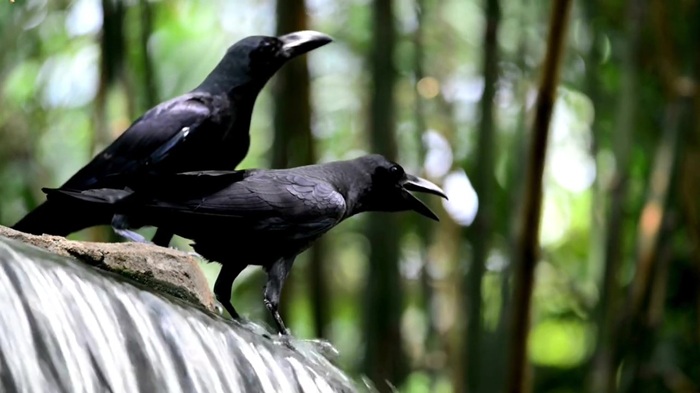
In controlled studies, researchers wore distinctive masks while capturing and banding wild crows.
Years later, when those same masks appeared again, even without nets or trapping equipment, the birds reacted defensively.
They scolded. They gathered. In some cases they mobbed the masked individual.
People wearing neutral masks did not receive the same treatment.
The birds were not reacting to clothing or posture. They remembered the face. More importantly, they remembered what that face represented.
This demonstrated not only facial recognition but long term memory tied to experience.
Why Crows Use Face Recognition as a Survival Tool
From a biological standpoint, this ability makes perfect sense.
Crows distinguish between humans who have harmed them and those who have behaved neutrally or even kindly.
That discrimination allows them to avoid real danger while conserving energy around safe individuals.
Rather than treating all people as threats, they fine tune their response. That level of selectivity reduces unnecessary stress and increases survival odds.
In urban environments especially, this adaptability is critical.
Crows thrive because they learn which humans to ignore, which to watch, and which to confront.
More Than Memory: Forward Thinking and Food Caching
Face recognition is only one piece of the puzzle.
Crows possess astonishing spatial memory. They remember where they cache food and can retrieve hidden items months later, sometimes close to a year after hiding them.
They also watch for potential thieves. If another crow or even a squirrel appears to be observing a cache site, the bird may quietly return later and move the food.
That behavior suggests forward thinking and an understanding that others have intentions. Few animals display that level of strategic planning.
Tool Use and Problem Solving
When people think about animal intelligence, chimpanzees, dolphins, or elephants usually come to mind.
Yet in certain controlled tasks, crows have performed on par with, and occasionally beyond, some primates.
Wild crows have been observed selecting appropriate tools for specific jobs. In laboratory settings, they have bent wires into hooks to retrieve food from narrow tubes.
That is not trial and error alone. It shows innovation.
Researchers also describe causal reasoning in crows. They understand cause and effect, solving multi step puzzles to access food rewards.
In structured problem solving tasks, their performance can resemble that of a young child working through a challenge.
Some comparisons place their cognitive abilities roughly in line with a 7 year old human in specific domains such as tool use, memory, and flexible learning.
How Crows Compare to Other Birds
Other birds are intelligent in different ways.
Pigeons are well known for navigation. Parrots excel at mimicry and memory. But crows stand out in innovative tool use and social intelligence.
While parrots may imitate sounds with impressive accuracy, crows often excel at figuring out complex environmental problems.
Their strength lies less in repetition and more in understanding.
Different regions of crows can even develop distinct vocal patterns that function almost like dialects. Their calls are not random noise.
They communicate warnings, food discoveries, and social information through specific vocal signals.
How Crows Communicate About Threats
Crows live in extended family groups. When one bird identifies a threat, it gives alarm calls that draw others to the scene.
Young birds observe and learn. Over time, recognition of a particular dangerous individual can spread socially through the group.
That is why multiple crows may respond to the same person, even if only one bird had the original negative encounter.
This shared learning strengthens the entire local population.
Why Face Recognition Matters During Nesting Season
During nesting season, defensive behavior intensifies.
If a person repeatedly approaches a nest or fledgling, adult crows may associate that individual with danger. Swooping or dive bombing can follow.
Outside of nesting season, the same individual may pass unnoticed. The memory remains, but the urgency changes. Parental instinct amplifies cognitive ability.
Spring aggression, therefore, is not random hostility. It is targeted defense built on recognition, memory, and social communication.
What This Says About Crow Intelligence
Facial recognition requires pattern recognition, long term memory, social awareness, and emotional weighting of past experiences.
Add to that tool making, multi step problem solving, food caching strategies, dialect like vocalizations, and cooperative family structures, and a clearer picture emerges.
What makes crows so fascinating is not just that they remember us. It is that they adapt to us.
Whether in forests, farmland, or city streets, they continue to refine their behavior based on experience. They learn from mistakes. They teach their young.
They navigate human dominated landscapes with flexibility that few species match.
When a crow locks eyes with you, it is not simply reacting.
It is evaluating.
Related Reading:
 Readers Digest Guide
|
 Golden Guide
|
 Your State Only
|
 Nat-Geo Guide
|

Gene Planker is the creator of Wild-Bird-Watching.com, where he shares over 50 years of backyard birding experience. His guides help readers understand the nesting, feeding, and behavior of backyard birds.



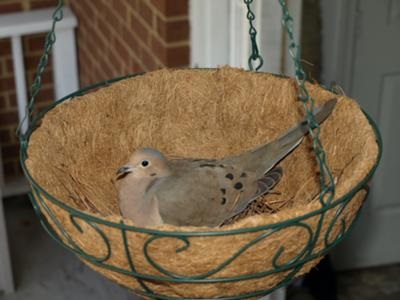

Before trimming shrubs or mowing, check for active nests. Many birds begin nesting earlier than expected, and a quick look can prevent accidentally disturbing a brood.


"What an awesome website. My little one and I enjoy playing the different bird calls and watching some of the videos, thank you!"
– Linda B., Illinois