Cedar Waxwing Nesting, Feeding, and Social Behaviors
Description
The Cedar Waxwing is a here-today, gone-tomorrow type of bird. One day your trees are quiet, and the next, a flock arrives and strips the fruit before you know it.
Cedar Waxwings are highly social birds that travel in flocks and feed mostly on fruit. They are known for their silky plumage, black mask, soft crest, and the unusual habit of passing berries from one bird to another.
This cooperative feeding is worth watching, especially when the birds are calling the whole time with their thin, high-pitched voices.
The sleek and handsome Cedar Waxwing is one of the most welcome avian visitors. Its silky plumage can make the bird look almost too smooth to have individual feathers.
Appearance: Size, Field Marks
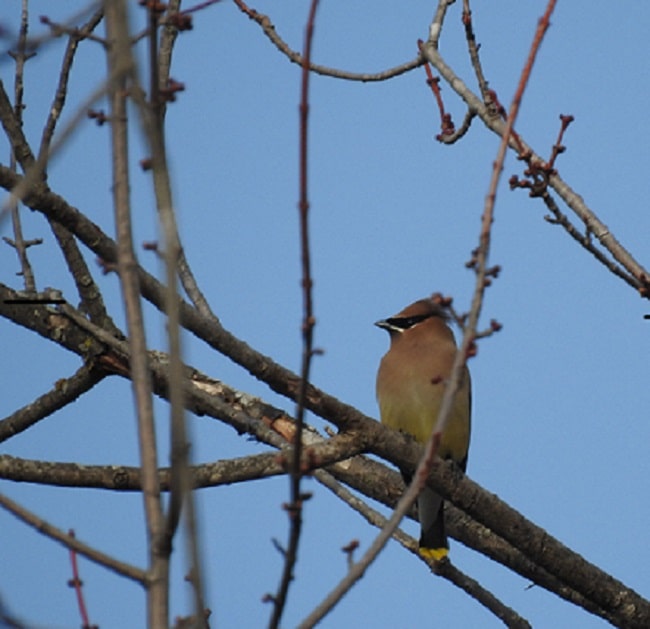
The Cedar Waxwing has an elongated crest and a black face mask. Its plumage is mostly brown and gray, with a black chin and throat and a soft yellow belly.
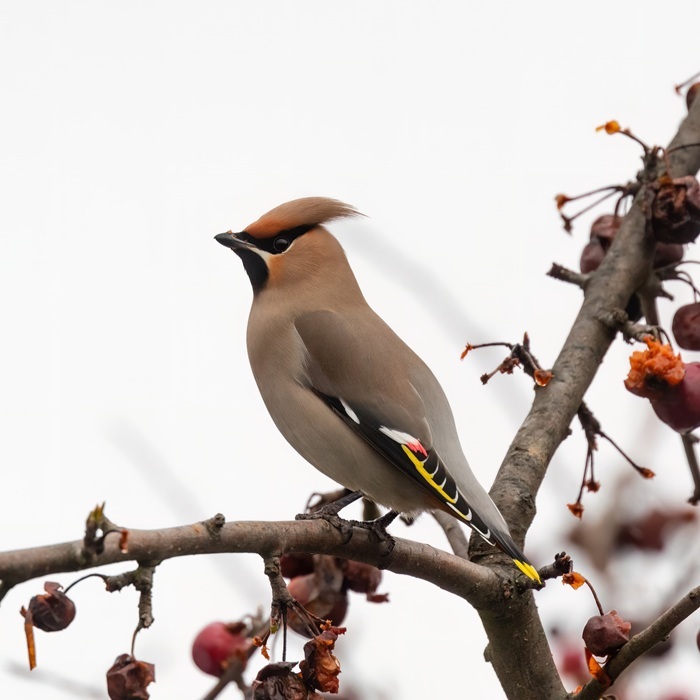
The species has a western cousin, the Bohemian Waxwing. Bohemians look similar, but they have a grayer belly, rusty under-tail coverts, and small white and yellow markings in the wings.
Both species have a yellow terminal tail band. That yellow color comes from carotenoid pigments found in the fruits they eat.
In recent years, some Cedar Waxwings have shown orange tail tips instead of yellow. This appears to be linked to birds feeding on fruits from exotic honeysuckles, which contain different pigments.
Another unusual field mark is the red wax-like tips on the secondary feathers. These red tips are more common on older birds.
The exact purpose of the red tips is still not fully understood, but birds with more red-tipped secondaries often breed earlier and may raise more young.
That suggests the markings may help signal fitness when choosing a mate.
What Do Cedar Waxwings Eat?
Cedar Waxwings eat mostly fruit, which makes up about 80% of their diet. They favor soft, sugary fruits such as cherries, crabapples, hawthorn berries, and juniper berries.
They were named for their strong attraction to the fruits of the red cedar, which is actually a juniper.
As red cedars declined in some areas because the wood was heavily used for fence posts, storage chests, and pencils, waxwings broadened their diet.
They usually feed near the tips of fruit-bearing branches and often hang upside down to reach a berry cluster.
Their fondness for sweet fruit is one reason they are so often seen in ornamental trees and shrubs.
Watch Cedar Waxwings feeding on berries:
During summer they also eat insects, especially protein-rich prey such as dragonflies and other insects caught on the wing.
Can Cedar Waxwings Get Drunk?
Yes. Cedar Waxwings are among the birds most often mentioned when fermented fruit causes intoxication.
After a frost, fruits may begin to ferment as sugars break down and yeast starts converting them to alcohol. Waxwings sometimes eat large quantities very quickly, faster than they can process the alcohol.
As a result, intoxicated birds may appear weak, disoriented, or unable to fly properly. Some are injured because they cannot recover fast enough.
Why Do Cedar Waxwings Pass Berries?
Cedar Waxwings are one of the few birds often seen sharing food.
When several birds line up on a branch, the bird nearest the fruit may pass a berry to the next bird, which may then pass it farther down the line.
This behavior is fascinating to watch and may help reinforce social bonds. It is also seen during courtship.
Cedar Waxwing Nesting Habits
Cedar Waxwings nest later in the summer than most backyard birds. This timing helps them match the nesting cycle with peak fruit availability.
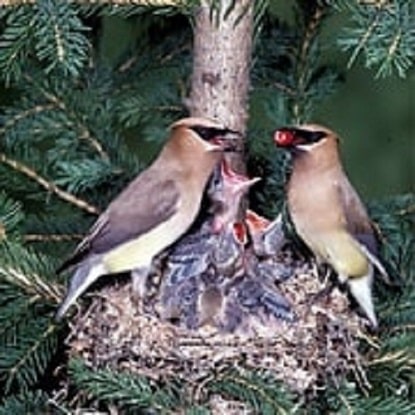
The nest is usually placed in a tree and is a bulky open cup made of grasses, shredded bark, rootlets, and similar materials.
It is lined with finer grasses, moss, and other soft material.
Both the male and female bring nesting material, but the female does most of the construction.
Egg-laying usually begins 1 to 3 days after the nest is completed. The female lays one egg per day until the clutch is complete.
| Cedar Waxwing Nesting Habits | |
|---|---|
| Eggs | 4 - 5 |
| Incubation | 12 days |
| Nestling Phase | 13- 14 days |
| Broods | 1 - 2 |
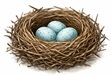
Cedar Waxwing eggs are pale blue or blue-gray with scattered black or gray blotches.
The female alone incubates the eggs for about 12 days. Nestlings remain in the nest about 13 to 14 days before fledging. One or two broods may be raised in a season.
Cedar Waxwing Call
Waxwings are very social birds and usually travel in flocks. It is uncommon to see just one bird by itself.
Their thin, high-pitched twittering often gives them away before you ever spot them in the treetops.
Habitat and Migration
Cedar Waxwings breed across much of North America, from the southern parts of Canada south into the northern United States and some northern Gulf Coast states.
Their winter range is centered in the southern United States, but this species is nomadic and irruptive.
That means it may appear almost anywhere in the country depending on fruit supplies.
Some birds winter as far south as Costa Rica.
Waxwings often begin gathering for fall movement in August, although some remain into October before moving on.
Keep an eye on neighborhood fruiting trees and shrubs. At almost any season, a flock of Cedar Waxwings can appear without warning.
Frequently Asked Questions
Do Cedar Waxwings Mate for Life?
Studies show that Cedar Waxwings usually stay together through the breeding season, but there is no clear evidence that they mate for life.
If they attempt a second nest, it is usually with the same partner.
Do Cedar Waxwings Eat Insects?
Yes. Although fruit makes up most of their diet, Cedar Waxwings also eat insects, especially during the breeding season.
They may fly out over water to catch emerging insects such as dragonflies, or they may hunt from a perch and sweep out to grab an insect in midair. This behavior is called hawking.
Do Cedar Waxwings Come to Feeders?
Cedar Waxwings are not regular feeder birds because they usually feed on fruit high in trees and shrubs.
A large platform feeder stocked with raisins, cranberries, grapes, or chopped apples may attract them, but more aggressive fruit-eating birds often get there first.
Credit: Eldon Greij, founding editor of Birder's World magazine and former president of Avian Enterprises. Reprinted with permission.


Before trimming shrubs or mowing, check for active nests. Many birds begin nesting earlier than expected, and a quick look can prevent accidentally disturbing a brood.

"What an awesome website. My little one and I enjoy playing the different bird calls and watching some of the videos, thank you!"
– Linda B., Illinois