Why Are Dove Nests So Flimsy? What Backyard Birders Need to Know
December 4, 2025
Dove nests are flimsy because doves build only the minimum structure needed to raise their young.
These simple twig platforms are designed to be quick to build, drain water well, and last just long enough for the eggs to hatch and the chicks to fledge.
If you have found a mourning dove nest in a hanging basket, porch light, or tree branch, it is normal to be surprised by how fragile it looks.
You may even see light through the bottom or notice that the sticks seem placed loosely.
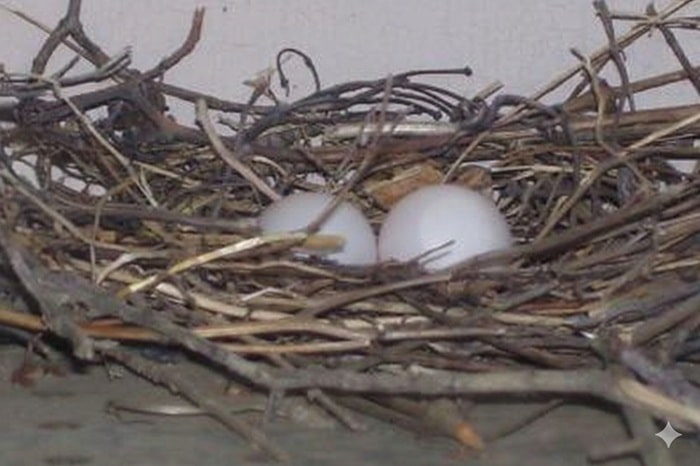
What looks weak to us works perfectly for the birds. Doves nest many times each season, so the goal is speed, not durability.
Their simple nests support their fast breeding cycle and have helped make them one of North America's most successful bird families.
Why Do Doves Build Such Simple Nests? The Speed Strategy
Dove nest construction takes just 2 to 4 days, a fraction of the time other backyard birds invest.
Watch a mourning dove pair build and you will see they often begin laying eggs before the nest looks complete. Compare this to:
- Robin nests: 5 to 7 days with mud lining
- Oriole nests: 12 to 15 days of intricate weaving
- Wren nests: 7 to 10 days with careful cup construction
This speed enables mourning doves to raise 5 to 6 broods per breeding season (March through October in many regions).
That is potentially 10 to 12 fledglings from one pair in your backyard each year.
Every day spent building is a day not spent raising young, so doves build the minimum nest needed to maximize breeding attempts.
How Long Do Dove Nests Need to Last?
From a bird's perspective, elaborate construction makes little sense. Doves rarely reuse their tree nests, even within the same season.
Why spend a week building something durable when it will be abandoned after one brood?
A dove nest only needs to function for approximately 4 weeks:
- Incubation period: 14 to 15 days
- Nestling period: 12 to 15 days
- Total time in the nest: 26 to 30 days
Research on dove nest success rates shows that structural collapse causes fewer than 10 percent of nest failures.
Predation (30 to 40 percent), weather extremes (15 to 20 percent), and human disturbance (10 to 15 percent) cause far more problems than flimsy construction.
Are Flimsy Dove Nests Actually Safe? Hidden Advantages
This sparse platform design offers several advantages:
Superior drainage: When storms hit your area, water drains immediately through the open construction instead of pooling around eggs.
This prevents chilling and protects developing embryos.
Predator resistant placement: The lightweight construction, only 2 to 3 ounces, lets doves nest on thin, flexible branches that will not support heavier predators like raccoons, cats, or crows.
What looks exposed to us is often a safe location for them.
Good for fast growing chicks: Dove nestlings develop and fledge quickly, leaving the nest at 12 to 15 days old compared to 14 to 18 days for robins.
By the time chicks might stress the nest structure, they are ready to fly.

What Should Backyard Birders Know About Dove Nests?
Do not add sticks or support to dove nests. The sticks are arranged correctly for the birds' needs. Human interference often leads to abandonment.
Expect multiple nests throughout the season in different locations. The same pair may build 3 to 5 nests in your yard from spring through fall.
Do not be alarmed if parents start a new nest while feeding fledglings from the previous brood. Doves often overlap breeding cycles. Males feed older fledglings while females prepare the next nest.
Common dove nesting locations in yards:
- Hanging planters and flower baskets
- Porch lights and architectural ledges
- Dense shrubs, especially evergreens
- Tree branches 5 to 25 feet high
- Old robin or cardinal nest foundations
Nest monitoring tips: Watch from a distance of at least 15 feet. Doves are skittish and may abandon nests if approached too closely.
Use binoculars instead of walking up to the nest.
Why Flimsy Nests Work
Despite having some of the simplest nests among backyard birds, mourning doves are North America's most abundant game bird, with populations over 350 million.
Rock pigeons live on every continent except Antarctica. Eurasian collared doves spread across Europe in about 100 years and are now increasing rapidly in North America.
If flimsy nest construction caused major failure, evolution would have selected for more solid nests long ago.
The fact that more than 300 dove and pigeon species worldwide build similar nests shows it is a successful strategy.
Conclusion: Understanding Dove Nest Strategy
The next time you find what looks like an incomplete dove nest in your yard, remember you are seeing an efficient design that has worked for millions of years.
Doves build only what they need. That simple platform represents the perfect balance of speed, energy savings, and reproductive success.
For backyard bird watchers, dove nests offer an important lesson: more effort does not always mean better results.
In the annual race to raise young, these simple nests do exactly what they are meant to do. The platform that takes three days to build often produces more young than elaborate nests that take weeks.
Key takeaway: Dove nests are not poorly built. They are perfectly suited to the dove's fast and frequent nesting strategy.
 Readers Digest Guide
|
 Golden Guide
|
 Your State Only
|
 Nat-Geo Guide
|

Gene Planker is the creator of Wild-Bird-Watching.com, where he shares over 50 years of backyard birding experience. His guides help readers understand the nesting, feeding, and behavior of backyard birds.



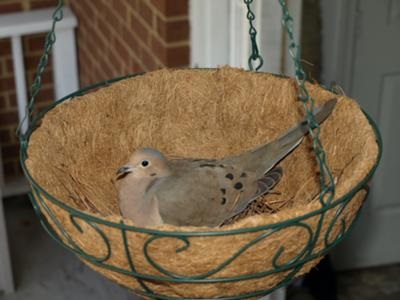

Before trimming shrubs or mowing, check for active nests. Many birds begin nesting earlier than expected, and a quick look can prevent accidentally disturbing a brood.

"What an awesome website. My little one and I enjoy playing the different bird calls and watching some of the videos, thank you!"
– Linda B., Illinois