Discover Springs First Flycatcher, the Eastern Phoebe
The Eastern Phoebe, springs first flycatcher, arrives at the first hint of buds beginning to burst from tree branches.
Sometimes they arrive before the snow has melted from their breeding territories.
The call of fee-bee is often confused with the call of the Black-Capped Chickadee bird.
However, whereas the Chickadee's call is drawn out and drops in pitch, the Phoebe's is explosive and rises sharply.
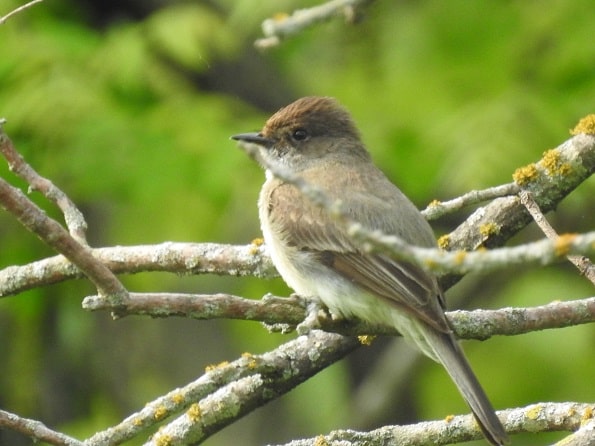
Description: Size, Field Marks
Measuring about 5 to 7 inches long with gray-brown above, and whitish below. No eye-ring or wing bars on this bird.
The top of the head is darker than the back and the bill and tail are dark.
After late summer molt, the belly may be a pale yellow.
Usually seen near water where insects are plentiful. The male sings loudly, trying to attract a female to his territory.
Eastern Phoebe Call
Mating Habits
Males defend territories of several acres.
While pairs are generally monogamous, male birds sometimes mate with a second female during the same breeding season.
This can happen while the first male Phoebe is feeding the fledglings, allowing an unguarded female to be bred by another male.
Most pairs stay together throughout the season, raising two or more broods.
Nesting Habits
The nesting season can begin as early as March in its southern range, where most migrate to in winter.
While some stay in the south year-round, most of the breeding populations nest throughout the eastern U.S. and into northern Canada.
By late April, most have paired and are nesting.
The nest is a cup of mud and moss, lined with fine grasses. This bird has adapted well to the structures of man.
Making use of under-street culverts, bridges, and overhangs of barns and garages.
The female does all the nest building and incubation. Often chasing the male away from the nesting site.
If a nesting site is well-protected, it will be upgraded and used for many years.
The female lays 4 to 5 white eggs, occasionally spotted with brown.
The eggs are incubated for about 14 to 17 days and the young will leave the nest in 15 to 17 days after hatching.
Eastern Phoebes will attempt to raise 2, sometimes 3, broods a year. Reuse of the nest after some remodeling is often the case.
| Eastern Phoebe Nesting Facts | |
|---|---|
| Eggs | 4 - 5 |
| Incubation | 14 - 17 days |
| Nestling Phase | 15- 17 days |
| Broods | 1 - 3 |
Cowbirds often lay eggs in this Phoebe's nest, and if hatched, the survivability of Phoebe chicks is unlikely.
Often nesting around humans, a nesting shelf placed under the overhangs of out-buildings and garages may attract a nesting pair.
Feeding Habits
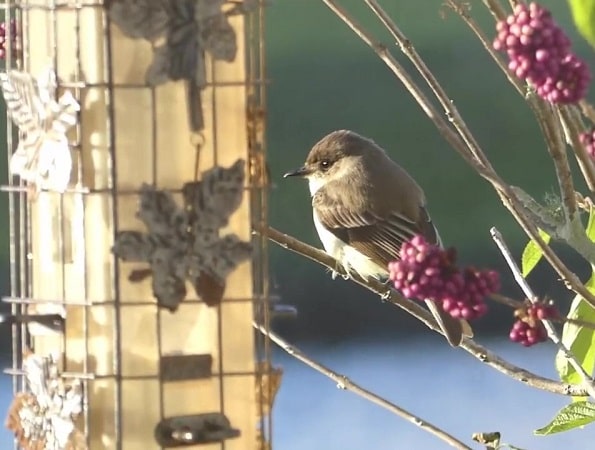
Eastern Phoebes eat a diet of insects and spiders captured in flight by watching from a limb, spotting, and then swooping out to catch their prey.
Another method is "hawking" which is hovering over the ground and catching insects as they take flight.
These birds will linger well into the fall, some will even attempt overwintering, shifting their feeding habits to small fruits during fall and winter, into early spring.
The Eastern Phoebe is the only flycatcher that winters in the southeastern U.S.
|
|
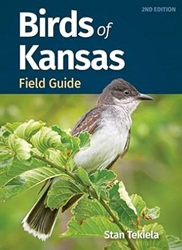
|

|
| Readers Digest Guide | Golden Guide | Your State Only | Nat-Geo Guide |


Fledging is happening Now! Keep cats indoors and stay with your dogs when outside.
Fledgling birds may be on the ground. The adults continue caring for their young for a week or two after they leave the nest.
"What an awesome website. My little one and I enjoy playing the different bird calls and watching some of the videos — thank you!"
– Linda B., Illinois