A Complete Guide to the Common Grackle Behaviors
Introduction
They nest in colonies, dominate bird feeders, and even use swimming pools to dispose of waste!
This guide uncovers their most unique mating, nesting, and feeding behaviors and how to manage them in your backyard.
Description: Size and Field Marks
Measuring about 12 inches in length, the Common Grackle (Quiscalus quiscula) is a medium-sized blackbird with a distinctive appearance.
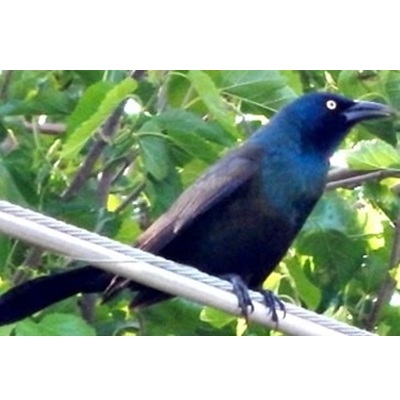
Common Grackle
It has a long, tapered tail and a strong, slightly curved bill.
Adult males have iridescent black feathers that can appear purple, green, or blue in certain lighting conditions.
Their eyes are a striking pale yellow, which contrasts with their dark plumage.
Females are slightly smaller and less glossy than males, with a more brownish hue to their feathers.
Both sexes have long legs and a somewhat flat head shape, which gives them a unique silhouette.
Common Grackle Call
Mating and Breeding Habits
The breeding season for the Common Grackle begins around mid-March and continues through April. By May most pairs have formed.
Mating rituals are simple. Following one female, several male Common Grackles will land around the female and perform several displays trying to attract her.
In-flight, males can be identified by their distinctive V-tail flight display during mating season.
As the mating and courtship season progresses, the number of males following a female decreases until only one male remains with her.
Nesting Habits: Building and Materials
Both males and females bring nesting material to the nest site, a process that takes from 1 to 4 weeks. However, this is not the actual act of nest building.
The female Grackle alone constructs the nest after this period, completing it in about 5-days.
The nest is made of grass, twigs, reeds, and mud, with the inside lined with finer materials.
You can find nests in shrubs or trees 3 to 30 feet above the ground or water.
Egg Laying, Incubations, Fledging
By mid to late April, the female will begin laying her clutch of 4 to 7 eggs that are pale greenish-brown with dark markings.
Incubation of the eggs will last about 13 to 14 days, with the young leaving the nest 12 to 16 days after hatching.
| Grackle Nesting Timeline | |
|---|---|
| Eggs | 4 - 7 |
| Incubation | 13 - 14 days |
| Nestling Phase | 12 - 16 days |
| Broods | 1 |
During this time, the male Grackle may guard the nest while the female feeds. Also, the male may pair with a second female during this time.
In such cases, he rarely returns to the second female, leaving her to raise the brood alone. Only 1 brood is raised per nest site each season, and second broods are rare.
Feeding Habits - Diet
Grackles will frequent backyard feeders in large numbers during spring and summer, feeding on a variety of seeds. Two of their favorites are sunflower seeds and cracked corn.
Sometimes, they can be a problem at feeders. They will empty the feeders so quickly and keep smaller birds away.
If they've become a problem for you, try selecting a type of feeder that restricts larger birds from getting to the seed.
Grackles will steal the young from other birds just as the other young hatch. I've seen newly hatched Cardinals get attacked by these aggressive birds.
They tend to attack very early in the morning. Usually, several will arrive at a nest site and cause the adult Cardinals to try to protect the nestlings.
While the Cardinals are chasing one Grackle, another Grackle bird steals the young.
Keeping Them Out of Bird Feeders
While you can always offer bird seed that they dislike, such as safflower and nyjer seed, this isn't always practical.
Limiting the type of seed you offer works, but it reduces the variety of birds visiting your feeders.
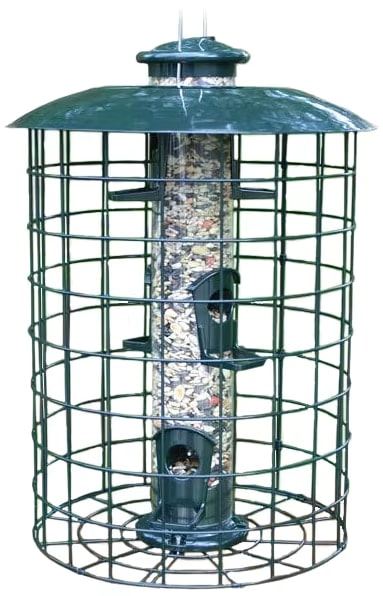
My preferred method is using Caged Bird Feeders, which allow the smaller birds to enter while keeping larger birds out.
In the Fall, Grackles form large roosts, which by winter, will include Red-winged Blackbirds, and Cowbirds.
These roosts can number in the tens of millions and become a nuisance in urban areas. Large flocks can also damage grain crops.
Lifespan
Studies show that Common Grackles live longer than most backyard birds. Lifespans of 6 - 7 years is common, with a recorded maximum of 22 years.
While some have lifespans beyond 7 years, their survival rate drops significantly after 8 years. UNM edu citation
Do They Mate for Life?
While Common Grackles are considered mostly seasonally monogamous, they do not mate for life.
Some males may even breed with other females while their first mate is incubating eggs.
Other Behavior
Common Grackles nest communally and have a habit of dropping their chicks' waste into swimming pools.
Some researchers believe this behavior mimics natural water sources like rivers, which carry waste downstream, helping to conceal nest locations from predators.
This tactic benefits the birds by reducing sent traces, but for pool owners, it results in frequent cleanup.
Unfortunately, little can be done except waiting for the young to leave the nest, at which point the behavior ceases.
Predators
Predators of the Common Grackle include squirrels and snakes which eat prey on eggs and young birds. Cats, raccoons, Hawks, and Owls also prey on them.
The Common Grackle is protected under the Migratory Bird Treaty Act.



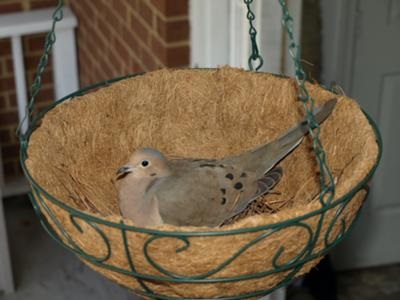

Fledging is happening Now! Keep cats indoors and stay with your dogs when outside.
Fledgling birds may be on the ground. The adults continue caring for their young for a week or two after they leave the nest.
"What an awesome website. My little one and I enjoy playing the different bird calls and watching some of the videos — thank you!"
– Linda B., Illinois