Understanding the American Crow Mating, Nesting, Feeding, Habits
Every bird-watching guide describes the American Crow as one of the most intelligent birds.
Other adjectives used to describe this bird are resourceful and mischievous.
Any way you describe them, these birds are worth watching as they go about their nesting and feeding habits.
One commonly seen habit of these birds is called "mobbing".
When you hear them giving harsh, drawn-out caws and see them diving into treetops, chances are there is a hawk or owl in the tree.
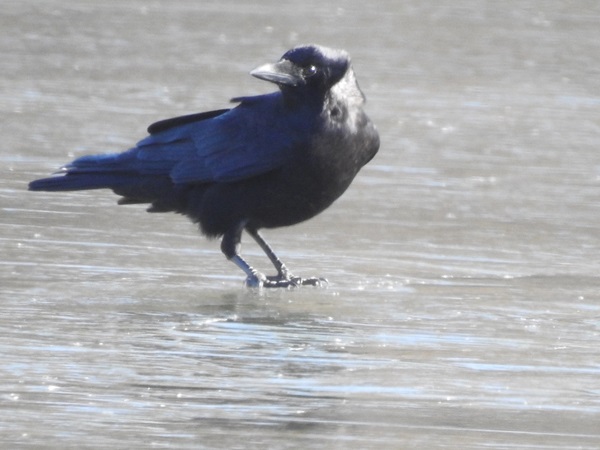
American Crow Standing on Iced Lake
The purpose is to drive off what they know is a predator of their young.
Even if the intruder leaves the area, the crows will continue to chase after it for a while longer, making sure it's gone from their territory.
One reason for this behavior, other than just chasing predator birds away, is to teach their young who their predators are.
According to the PBS Nature Program "A Murder of Crows", (link to DVD below), these birds may distinguish between one human and another.
Crows Mobbing Hawk Out of Territory
Crows may be able to communicate to others whether a certain human is to be feared by recognizing features and remembering past actions.
American Crow Call, Sound
Description What do Crows Look Like?
The American Crow is 17 to 21 inches in length. All black with a fan-shaped tail.
Both males and females are similar in appearance. The Crow's voice is the best way to distinguish it from other all-black birds.
The voice is a long, descending "caaaw". Although it has a variety of other calls which are important to its system of communication.
Mating Breeding Behavioral Habits of Crows
The mating and breeding habits of the American crow take place on the ground. Crows begin mating around mid-March.
The males have a courtship display which consists of facing the female and fluffing their body feathers out.
Then he partially spreads his wings and tail and proceeds to bow repeatedly while uttering a brief rattling song.
How Do Crows Mate?
Crows, like most birds, reproduce through sexual reproduction. The male crow mounts the female to transfer sperm, which fertilizes the eggs inside the female.
The female then lays the fertilized eggs, which develop and hatch into chicks.
This is the physical process of breeding for crows.
Once a male and female have mated, they perch together and may touch bills and preen their mate's feathers.
This mating behavior may not be seen very often because Crows mate for life.
Pairs already mated rarely have courtship displays. They breed or mate in the same way as other birds and mammals.
Pairs that are unsuccessful at breeding will part ways and return to their families.
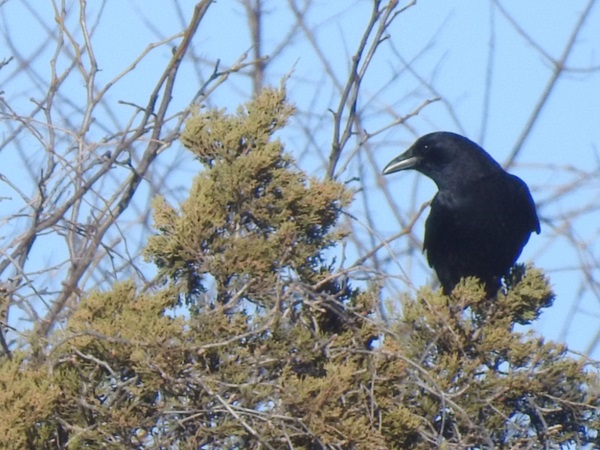
American Crow in Treetop
Should a mate die, the surviving mate will eventually find a new mate.
Crows also demonstrate cooperative breeding. This is when the previous year's young help raise the newest brood.
You can read more about cooperative breeding in our article here - Helper Birds
It's not unusual for males to wait a few years before mating.
Nesting Habits and What a Crows Nest Looks Like
Crows are very secretive around their nest. While noise is a mainstay of its behavior in other areas, the nesting site is quiet.
Nesting can begin as early as March; construction of the nest takes about 2 weeks to complete.
Spring storms can destroy nests. This may cause nest construction to last through June.
Where Do Crows Nest?
It'sdifficult to find where crow's nest, but here are some clues. Crows place their nest in the top 1/3 of the chosen tree 18 to 60 feet above the ground.
They make sure the nest has a canopy of leaves above that hides it from predator hawks.
They build the nest near the trunk on a horizontal limb.
Nest Construction and Use
The female is the primary arranger of the nest. Both adults bring twigs and sticks for the outside and bottom of the nest.
The inside will be lined with bark, grass, and moss horsehair, or fur. The nest is about 15 to 16 inches in diameter.
Last years young may bring nest material to the female and she will use it in the nest building. The sides of the nest can be 9 to 10 inches high.
Crows do not use the nest in winter. They will roost or sleep in large numbers in a group of trees.
Most nests are abandoned after a single use, although a new nest may be built in the same tree the following season.
You can see what a typical American crow's nest looks like in the picture below.
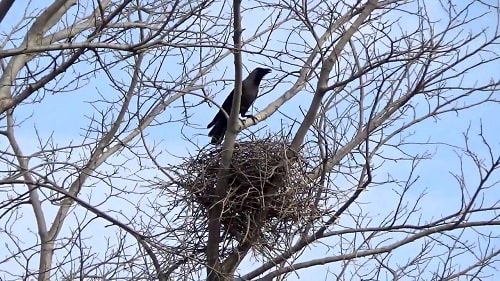
Crow at Nest Site
Eggs, Incubation, Baby Crows
The female lays 3 to 7 eggs that are bluish-green with brown marks.
Incubation (gestation period isn't used for birds)is primarily done by the female with the male close by and sometimes feeding her.
The eggs will hatch after 17 - 20 days of incubation.
The young are born blind and flesh-colored. After about five days, their eyes will open for the first time.
| American Crow Nesting Stats | |
|---|---|
| Eggs | 3 - 7 |
| Incubation | 17 - 20 days |
| Nestling Phase | 33 43 days |
| Broods | 1 |
Both parents feed the young, receiving help from previous years young.
At 4 - 5 weeks of age, the fledglings will leave the nest. Mostly they stay in the nest tree for several days while adults continue feeding them.
Crows only lay eggs once a season unless a storm or predator attack interrupts the first attempt. They may decide to re-nest in those cases.
Young males will return to their parents if their first attempt at mating and nesting is unsuccessful.
Feeding Habits - What Do Crows Eat?
The diet of Crows consists of insects and small reptiles. They will also eat eggs and nestlings of other birds.
Included in their diet are carrion, fruit, and crops such as corn.
Video Of Crow Eating Sunflower Seed Beneath Feeders
Crows tend to be opportunistic feeders, eating whatever is available.
During the nesting season of other songbirds, you may not want to use bird feeders if you have Crows around.
They will find a songbird nest and feed from those nests.
Crows are the wariest while feeding. Feeding in flocks of 5 to 7 birds, they will arrive on their feeding territory, landing in the trees.
While most will begin feeding on the ground, one or more will remain in the trees watching for predators.
Cracked corn and sunflower seeds will attract these birds, although they will eat about any kind of seed.
Where Do Crows Go at Night to Roost and Sleep?
In fall and winter, the American Crow roost in large flocks, numbering sometimes in the thousands.
Each day in the late afternoon, the birds begin flying along fixed routes to pre-roost sites, gathering with other flocks and moving to the final roost.
They may fly as far as 50 miles every day to join the roost.
Once there, they quiet down for the night, waiting for dawn to fly back to their feeding territories.
Why Do Crows Fight With Each Other
I'm asked from time to time why crows fight with each other, even to the death.
Sometimes it's as simple as not being a family member.
Crows on Ice
While they are social birds, they may chase away those not of the family to protect territory or mates.
It may seem cruel, but sometimes a sick, injured or otherwise physically compromised bird may be attacked by others.
Weak animals are always at risk from predators. These birds may have some sense of that vulnerability.
Why Do Crows Dip Their Food In Water?
Another question that comes up is, why do they moisten their food in birdbaths and other water sources?
No one knows for sure. Theories exist. Some believe they are cleaning their food.
Since crows are intelligent opportunistic feeders, eating food from human trash and landfills, it's believed by some that they've evolved to clean their food before eating.
Another thought is that they use water to moisten dry food and soften hard food types such as peanuts.
Still, others believe crows dip their food to provide moisture for the nestlings during the nesting season.
This would provide water to the young while still in the nest. See, How Baby Birds Get Water in Nest.
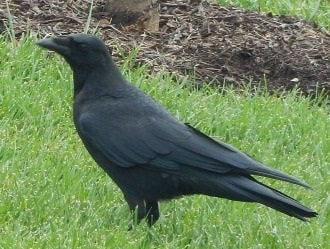
American Crow
Each theory is plausible, but as stated, it's not known for sure.

|

|

|

|
| Birds and Blooms | Pioneer Woman | People Magazine | First For Women |