Discover the Purple Martins Mating, Nesting, and Feeding Habits
Once you attract a colony of nesting Purple Martins, your summers will never be the same. That's a promise!
Year after year, they'll return to bring you the joy of watching their mating, nesting, and feeding habits close up.
Purple Martins are the largest of the North American swallows and one of the few birds that allow you an opportunity to have a hand on approach to bird watching.
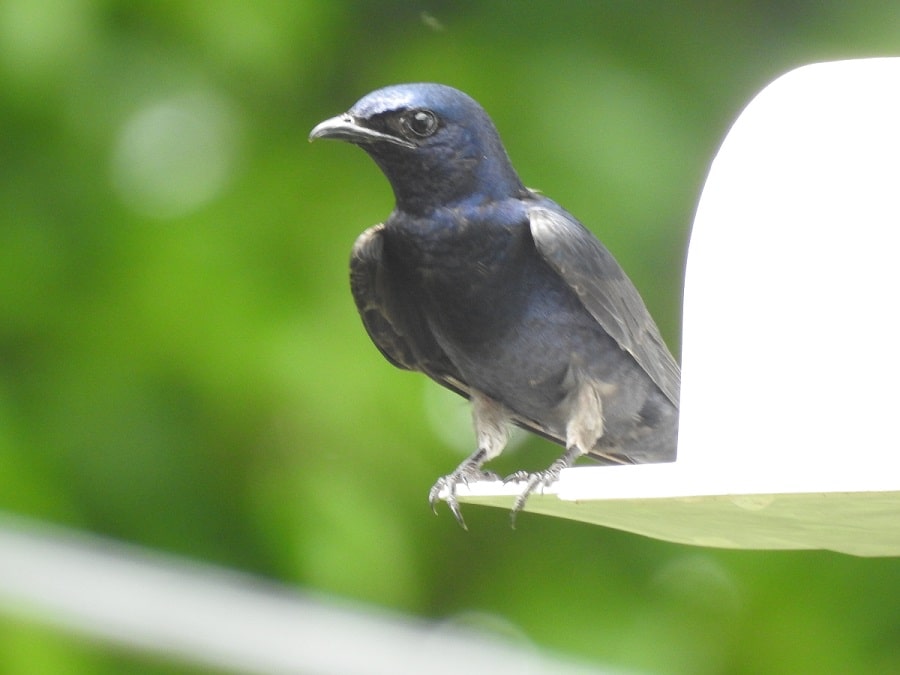
ASY Male Purple Martin
Purple Martin Call
Description Male
Purple Martins measure about 8 inches in overall length. The tail is slightly forked.
Adult males in their second year or older have a dark, glossy purple-blue plumage on their back and head, while their wings and tail feathers are entirely black with a glossy steel blue sheen.
These second-year adult males are the easiest to identify. When starting out, it's easy to make a mistake in identifying Starlings and/or Tree Swallows for Purple Martins.
Once you've made a positive identification and heard their vocalizations, you'll never make that mistake again.
What Female and Subadult Martins Look Like
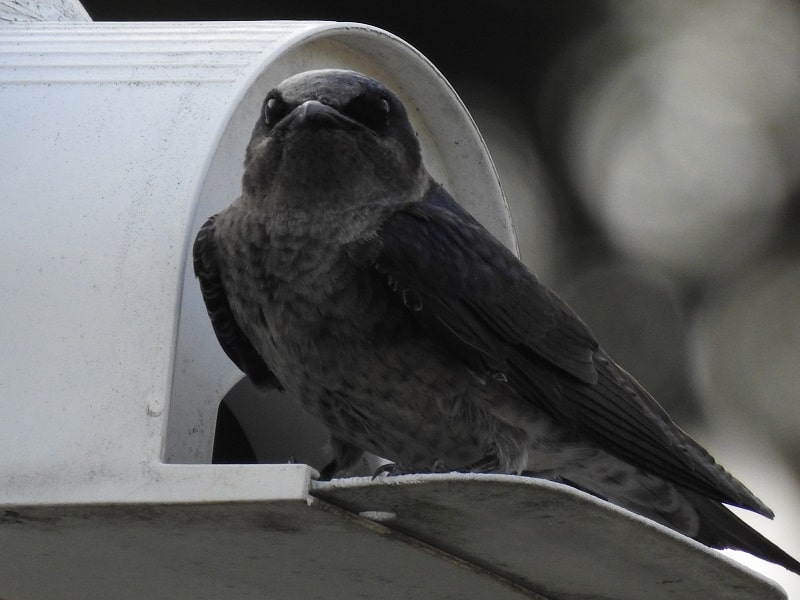
Female Purple Martin
The females have a more subdued coloration, with a grayish-blue head and back, and a paler belly.
Juvenile birds have brownish-gray plumage that gradually turns into adult colors as they mature.
Subadult females (those who've made a single migration trip) look like adult females without the steel blue sheen on the back.
Subadult males are a little easier to identify. Looking similar to females, but they have solid black feathers on their chests in blotchy, random patterns.
Mating Habits
Older adult males generally return first from their wintering grounds in Brazil to claim nesting cavities at the same site as the previous year, provided that the nesting site is still available.
These first arrivals are sometimes referred to as scouts. The term scout is misleading as they return to the same nest site each year and do not scout for new territory.
Occasionally, adult females will get to the nesting site first. Males will try to attract a female to a selected nesting cavity of his choosing.
The female will pick which she desires and the male, regardless of which cavity he may have preferred, will follow the female to her selected site.
About four weeks after the adults arrive, the subadult Martins (those returning from their first migration) will return to mate for their first nesting season.
The young males may fight with each other and even older males to mate with any available females.
Those males that are in full adult plumage, second year or older, aree preferred by the females for breeding.
Nesting Habits
To the east of the Rocky Mountains, the Purple Martin is mostly reliant on human-made housing.
It's important for the individual hosting these swallows to provide the best housing and management techniques they can provide.
Martins prefer nesting in larger cavities than was once thought. Most manufactured housing was a 6-inch by 6-inch cavity.
Smart manufacturers are making housing cavities with more depth, approaching 11 inches deep and 7 inches wide.
Natural and Plastic gourds are used and provide the martin's deep and wide nesting cavities.
Gourds can also protect from flying predators like owls, keeping the owls from reaching inside, and pulling the nestlings out.
The nesting behavior can be watched with relative ease. Females will begin gathering nesting materials and bringing them back to the nest cavity.
Flying to the top of a tree, Martins will tear a leaf off with its beak and bring it back to the nest site.
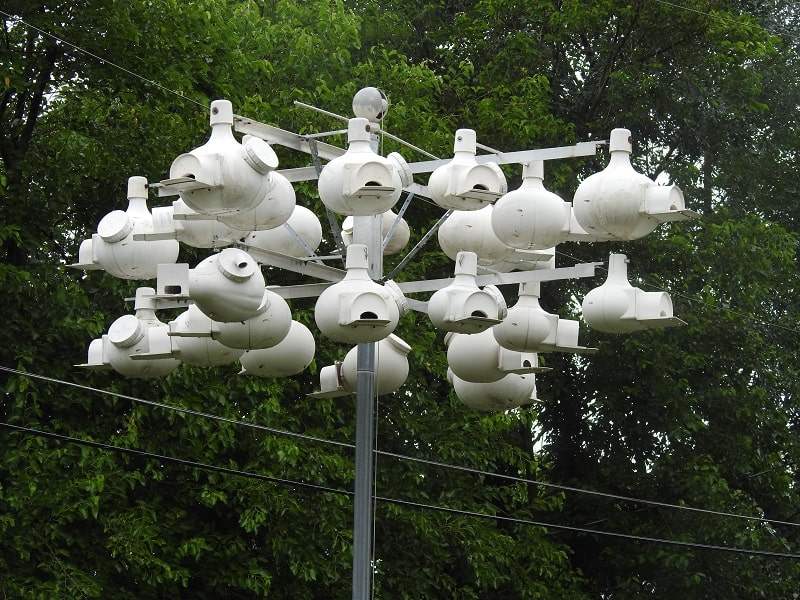
Purple Martin Gourd Rack with 24 Nest Cavities
If you watch a single pair, you may notice each time the female enters the nest, the male will be outside and sing a few notes of his song.
This may be to let her know he is nearby while she is inside the nest.
The nest is made from natural materials available in the area: pine needles, grass, sticks, straw, and leaves. Nest building takes anywhere from 1 to 2 weeks.
The female lays 3 to 7 white eggs with an average of 4 per clutch. Generally speaking, younger females lay fewer eggs than more mature females.
Incubation is done by the female, although the male may sit on the eggs from time to time. Males do not have a brooding patch and can not incubate eggs.
An interesting note for birdwatchers not familiar with Martins is that incubation is not continuous.
Instead, the eggs are covered with leaves while both males and females go feeding, leaving eggs unattended in the afternoon.
This can be a dangerous time as House sparrows, House Wrens, or Starlings can enter and destroy the eggs during this time.
Incubation lasts for about 15 to 17 days. The young will stay in the nest anywhere from 28 to 32 days before leaving.
| Purple Martin Nesting Stats | |
|---|---|
| Eggs | 3 - 7 |
| Incubation | 15 - 17 days |
| Nestling Phase | 28- 32 days |
| Broods | 1 |
Once the young fledge the nest, the parents will continue to feed them and teach them how to catch food.
When the young learn how to take to the skies and catch their own food, they won't have to rely on their parents for survival.
Often the young are brought back to the nest in the evening during the first week or two after fledging. If hawks or owls have been a problem, the young may not return after fledging.
Also, if conditions of the nest site have been poor due to mite infestation or wet nest, the young may never return at night.
The aforementioned issues are good reasons for doing nest checks and using good management practices when hosting Purple Martins.
Feeding Habits
Purple Martins are aerial insectivores. They typically feed on the wing, swooping and diving to catch their prey in mid-air.
Their diet consists of a wide variety of insects, dragonflies, damselflies, cicadas, grasshoppers, katydids, moths, butterflies, wasps, beetles, stink bugs, mayflies, bees, midges, and horseflies.
The myth about Martins feeding on mosquitoes is just that, a myth. While they may eat a couple, mosquitoes are not a primary food. Just a good way to sell birdhouses.
Predators
Do You Host Purple Martins In Your Yard? Please share your story. What type of housing do you have? How many Purple Martins are using your housing? And Most of All, share a picture of your site. - To share your Purple Martin story Share Here
These birds have many predators and it is incumbent on Martin landlords to do all they can to protect the birds they are hosting.
Predators include Hawks, snakes, raccoons, European Starlings, House Sparrows, Owls, and cats.
Using predator guards and netting on poles will keep snakes and 4 legged predators from climbing the pole and destroying the Purple Martins.
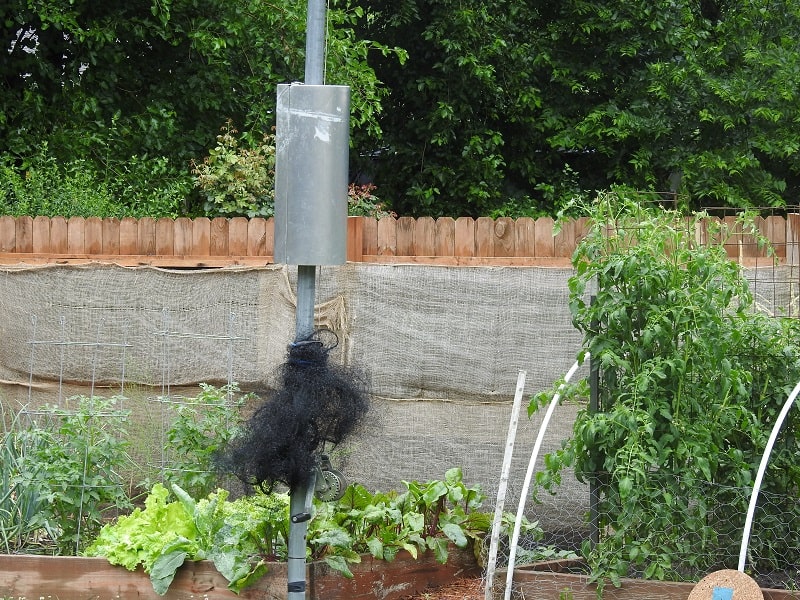
Predator Guard and Bird Netting on Pole
Trapping and eliminating European Starlings and House Sparrows is a must for the Martins to survive. Keeping these two species at bay is the only way to host Martins.
These two introduced species do more harm to our native cavity nesters than any of the native species.
Our native birds have not developed defenses against these two species of bird. Keeping cats indoors at least during fledging time can be helpful.

|

|

|

|
| Birds and Blooms | Pioneer Woman | People Magazine | First For Women |

Love Martins - Tell Us About Them
Talk all you want about your colony or how much you want to start one.
Make sure to add 1 and up to 4 photos of what you have in the way of housing type.
What Other Visitors Have Said
Read what others have shared.
Purple Martins in 2023 Our Journey
Wow! it's been 15 years since the Wild-Bird-Watching Purple Martin setup was first established.
I began with a 12-unit S&K plastic martin house and …

Purple Martin Sharing
First year with Martins. I have 2 females one adult one sub adult and 1 adult male. They are nest building in side by side units of 12 unit house.

Purple Martins Housing and Stories
This was the Wild-Bird-Watching.com Purple Martin Set Up for 2009.
Two S&K Best Houses converted to 6 large rooms each.
We added 8 of the new S&K …