Exploring the Baltimore Oriole Nesting, Feeding Habits (Northern)
- Males arrive on their breeding grounds by mid-April - May, with females arriving about a week later.
- Nest building can begin within 1 - 2 weeks after the females return.
- A diet of fruit and insects sustains them through breeding season.
- Oranges, sugar water, and plain grape jelly attracts them to feeders.
- Orioles do not mate for life.
Description: Size, Field Marks, Male Baltimore Oriole
The male Baltimore Oriole measures 7 to 8.5 inches long and is black with orange underparts, rump, shoulders, and sides of the tail. His wings feature two white wing bars.

Males generally arrive a few days to a week before the females and begin claiming territories.
How Do Female Baltimore Orioles Differ From Males
The female Baltimore Oriole looks quite different, with an olive-colored back and a yellowish underside. She also has two white wing bars and both are found east of the Rockies.
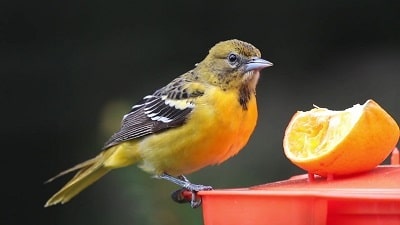
Bullock's Oriole, the western counterpart, shares a similar appearance. The male has an orange face, a black eye-line, and a large white wing patch. The female has a yellowish head and breast with a whitish belly.
The Baltimore Oriole was named after George Calvert, Lord Baltimore, whose coat of arms displayed the same black and orange colors.
The Major League Baseball team later adopted the bird's name and colors.
Because Baltimore and Bullock's Orioles interbreed in the Central Plains and have similar habits, the American Ornithologists' Union once classified them as a single species, the Northern Oriole.
However, research on their relationship continues.
Oriole Nesting Season and Habits
Males arrive on their breeding grounds by mid-April - May, with females ariving about a week later. Nest building can begin within 1 - 2 weeks after the females return.
The female selects a site for the nest, usually in a deciduous tree, often a tall one. Orioles prefer trees such as Elm, Cottonwood, or Maples to build their nest.
The nest is typically located at the end of a branch, which provides some protection against predators.

The female gathers materials for the nest, which can include plant, animal, and even human-made materials.
This often includes grass, bark, hair, and twine. She may also use spider silk as a binding agent.
How Orioles Build Their Nest
The female weaves the nest, creating a small cup shape. She starts by weaving a loop around a twig.
Then she weaves additional material, including long grasses and strips of bark, in and out of the loop. The weaving process can take as long as a week.

Once the basic structure is complete, the female lines the inside of the nest with soft materials, such as plant down, fur, or feathers, to provide a comfortable and warm environment for the eggs and chicks.
The outside of the nest is often decorated with gray and white lichen, which helps to camouflage it against the tree.
Nest can be anywhere from 6 to 90 feet above the ground.
While it's quite common for them to return each year to the same territory, they will not use the same nest.
They often take parts of the old nest to build a new one, so you may see them at the old nest site.
Bird watchers will find the best viewing of the Baltimore Oriole's nest when the leaves are off the trees. You'll see them at the end of branches high in shade trees.
The preferred habitat of Orioles is in open woodlands of deciduous trees near parks, gardens, and suburban settings.
Egg Laying, Incubations, Fledging
By mid to late May - early June, the female will begin laying her clutch of 3 to 6 pale blue with dark marks eggs.
Incubation will last 12 to 14 days and the young birds will leave the nest in 12 to 14 days after hatching.
| Baltimore Oriole Nesting Timeline | |
|---|---|
| Eggs | 3 - 6 |
| Incubation | 12 - 14 days |
| Nestling Phase | 12 - 14 days |
| Broods | 1 per season |
Northern Orioles nest only once each season and do not use birdhouses.
Cowbirds have a difficult time laying eggs in the Oriole's nest but still do.
Orioles can tell the difference between their eggs and Cowbird's eggs. Either the Oriole will eat the Cowbird's eggs, or eject them from the nest.
Feeding Habits - What Do Baltimore Orioles Eat?
The main diet of the Baltimore Oriole consists of insects, fruits, and flower nectar.
At the feeding station orange halves or grape jelly placed in a shallow bowl will draw them in.
Another option is by providing a sugar-water mixture. 1 part sugar to 4 parts water. No need to boil the sugar-water mixture. Replace often during hot weather.
Oriole Mating Habits - Rituals
The breeding season begins in late April to early May. The males arrive 2 or 3 days before the females and begin claiming their territories.
You're likely to hear them singing from treetops in their effort to attract a mate. Their singing is almost constant until they mate with a female.
Unlike the Northern Mockingbird though, these birds do not sing at night.
Generally, any singing late in the season is from unmated or immature birds.
Once the birds have found a mate they defend their territory and begin nesting.
Do Orioles Mate For Life?
Considered sesonally monogamous with extra-pair copulation common, the Baltimore Oriole does not mate for life.
What are the Predators of Oriole Birds?
Of the avian type, predators of the Northern Oriole include Screech Owls, Common Grackles, Crows, and Blue jays. Others are Red squirrels, Gray Squirrels, and Fox Squirrels.
What Does the Baltimore Oriole Call/Song Sound Like?
The song of the Baltimore Oriole is a beautiful melodic sound that can be described as a series of flute-like notes.
The exact song of an oriole can vary slightly between individuals, but it typically consists of a series of musical phrases, often with descending notes or slurred phrases.
The song is used by male orioles to establish territories and attract mates.
Where Did My Orioles Go Early Summer?
Often we're asked "What happened to our Oriole birds"? "they were here every day eating our oranges and grape jelly and now they're gone".
The simple answer is that Orioles often disappear from feeders because they switch to a protein-rich diet while nesting and feeding their young to ensure healthy growth.
This means they are hunting insects instead of visiting your feeders. They also may have started migrating south.
Don't worry, sometimes the adults will bring their young to the feeders once they've left the nest. So be prepared for a return after a 4-week absence.
When Do Orioles Migrate?
Spring migration begins in April when Male Baltimore Orioles begin to arrive at their breeding grounds roughly East of the Rockies.
The winter migration to the South can begin as early as July, which is much earlier than most species.
Still, you may see some Orioles well into September or a little later in their Southern range.
Related Reading: Orchard Oriole Habits.
 Fruit Feeder |
 Oriole Nectar Feeder |
 Covered Feeders |
 Suet For Orioles |

Gene Planker is the creator of Wild-Bird-Watching.com, where he shares over 50 years of backyard birding experience. His guides help readers understand the nesting, feeding, and behavior of backyard birds.