Exploring the Tree Swallow Nesting, Mating, Feeding Habits
The Tree Swallow is one of the first of our swallows to arrive in early spring.
Leaving their wintering grounds in the southern United States, Mexico, and Central America, the Tree Swallows return to begin their mating, nesting, and feeding habits in our backyards.
Description What they Look Like
Tree Swallows are 5 to 6 inches long. The Male has iridescent blue upperparts and bright white underparts.
In fall, the upper parts may appear greenish. The female has duller, brownish, upperparts and grayish underparts.
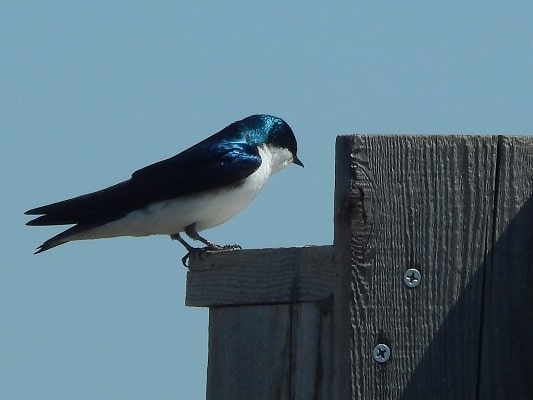
Tree Swallow
The female has an immature plumage in the 1st year (sometimes 2nd year).
This allows her to approach breeding adult birds and their nest without being chased from the pair's nesting site.
If anything happens to the breeding female and she dies, the younger female Tree Swallow can replace her. This helps ensure a successful breeding season.
Tree Swallow Call
Mating Habits
Soon after arriving on their breeding grounds in mid-March to mid-April, courtship begins.
The birds perch near their nest holes or on top of nesting boxes.
Flutter-flight and bowing displays from the male are done in front of the females.
Occasionally, one may see these birds billing. This is the practice of a mating pair touching bills with one another.
Actual mating occurs about a week before egg-laying begins.
Do Tree Swallows Mate for Life?
Strong nest site fidelity may be the reason that some pairs mate in consecutive seasons. However, they do not mate for life.
Tree Swallow Nesting Habits
Tree Swallows prefer open areas near water in dead trees at the water's edge for nesting.
Tree Swallow at Birdhouse
Tree Swallows are cavity-nesting birds and make ideal candidates for man-made birdhouses.
Competition from House Wrens and House Sparrows makes it even more important to place and monitor birdhouses for these graceful flyers.
Woodpecker holes are in short supply by the time these swallows arrive and nest sites are fiercely defended.
Tree Swallows typically arrive before Purple Martins and may compete for the same nesting cavities.
If you're a Purple Martin landlord, try to provide a separate nesting cavity for these birds. They seem to prefer south-facing nest boxes.
Keep your Purple Martin housing closed until the Tree Swallows select other housing that you've placed for them.
You'll notice a slotted opening on the birdhouse built for this bird. This makes the house a little more resistant to House Sparrows.
The territory that they defend is only the area of the nest itself.
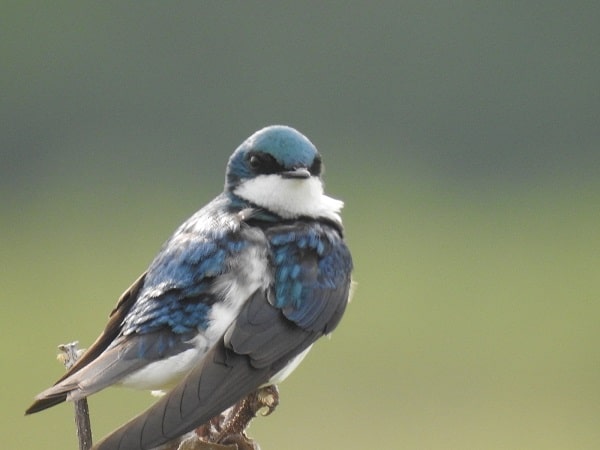
Tree Swallow Perched on Reed
If predators or human visitors approach the nest while the birds are around, the birds may swoop toward the intruder and turn at the last minute, just narrowly missing the intruder.
The nest is built primarily by the female, although the male does some gathering of materials.
The nest is cup-shaped, made of grasses for a foundation, and lined with feathers.
The nest-building process can take as long as a month, but 2 or 3 weeks is average.
Egg laying begins early in May when the female begins laying 1 egg each day until a clutch of 4 to 7 white eggs are laid.
Incubation is by the female and lasts 13 to 14 days, but can go longer if weather is colder.
Sometimes, the nest may be abandoned for a few days during egg laying, even during incubation times.
During this time, you'll see no activity around the nesting site. Within 3 to 4 days, the birds return with eggs still viable.
This leave-of-absence does not affect the success of the young birds hatching, only delaying the event.
| Tree Swallow Nesting Stats | |
|---|---|
| Eggs | 4 - 7 |
| Incubation | 13 - 14 days |
| Nestling Phase | 18- 20 days |
| Broods | 1 |
After hatching, both males and females provide food for their nestlings.
The young birds will leave the nest on average about 18 to 20 days after hatching. But can be in 15 to 25 days.
One brood is raised each season. Renesting may happen if the early nest fails or is abandoned.
In some extreme western or southern populations, Tree Swallows may raise a second clutch. This is not a common event.
Do Tree Swallows Use the Same Birdhouse Each Year?
Tree swallows typically use different birdhouses for different seasons.
During the breeding season, which typically occurs from April to August, they will use a nesting box to build a nest and raise their young.
After the breeding season, the birds will abandon the nest and may not return to that same birdhouse the following year.
However, other Tree Swallows will use your birdhouse if cleaned. Having multiple birdhouses will keep them coming back.
Feeding Habits - What Tree Swallows Eat
Tree Swallows are insectivores, which means they primarily feed on insects.
They are aerial foragers and catch insects on the wing, using their agility and speed to chase down prey.
They feed on a wide variety of flying insects, including midges, mosquitoes, flies, beetles, and moths.
Tree swallows are also known to eat spiders, and occasionally they will eat fruits such as bayberries.
You'll find them feeding over water, where insects are more abundant, or in fields and meadows where they can catch insects as they fly above the vegetation.

Tree Swallow Migration Habits
Tree swallows typically begin their migration by late July or early August, with birds in the northern part of their range leaving earlier than those in the south.
They migrate during the day and can travel long distances, sometimes covering up to 500 miles in a single day.
They often follow rivers or coastlines, where food and shelter are plentiful.
During migration, tree swallows form flocks and roost together at night, sometimes in large communal roosts.
These roosts can contain thousands of birds and are often found in reed beds or other areas with dense vegetation and plenty of flying insects to eat.
Once the Tree Swallows reach their wintering grounds, they typically stay there until late winter or early spring.
In early spring, the large flocks break up into smaller flocks and begin their northward migration.
Males typically arrive at breeding sites before females, and both sexes establish territories and begin searching for nesting sites.
You may also like reading about The Habits of Barn Swallows

|

|

|

|
| Birds and Blooms | Pioneer Woman | People Magazine | First For Women |