Scarlet Tanager Mating, Nesting and Feeding Habits
The male Scarlet Tanager may be a brilliant red during the breeding season, but it's more likely that you'll hear him than see him.
Perching high atop the forest canopy, his singing offers the best clue to his presence.
Making the longest trip of the four species that travel north, this bird arrives from the Andes each year just as the buds are flowering.

Male Scarlet Tanager
Description What They Look Like
The Scarlet Tanager measures 6 1/2 to 7 1/2 inches in length. Breeding males are recognizable due to their striking red plumage, which covers their body, head, and throat.
They have black wings and tails, and their bill is pale and slightly curved.
In contrast, females have olive-yellow feathers on their upperparts and a yellowish hue on their underparts.
The female has a yellowish breast with a belly that is greenish back. Her wings are a grayish brown.
Immature males have patches of red and yellow with wings and tails dark brown. Immature females look like adult females.
Scarlet Tanager Call
Males are known for their distinctive song, which is a series of short phrases and can be described as a hoarse robin-like warble.
Beginning at the end of July or early August, the male bird molts from his bright red and black alternate plumage to a more subdued, female-like plumage.
Individual birds show varying degrees of red splotches until molting is complete.
Mating Courtship Habits
As soon as they arrive in the Spring, males stake out and aggressively defend territories.
During courtship, the habits of the male change.
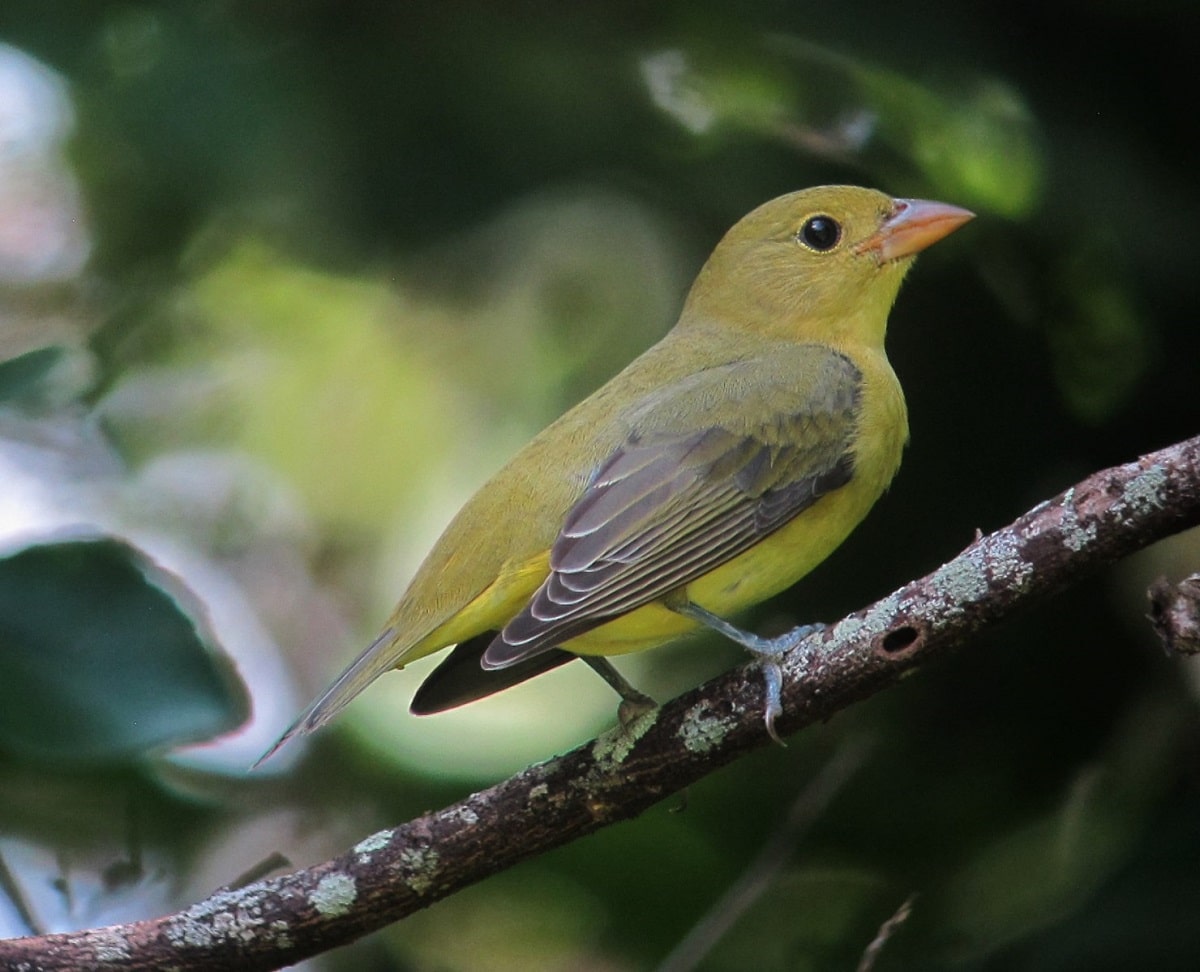
By Felix Uribe, CC BY-SA 2.0, Female Scarlet Tanager
Instead of singing high atop the trees as he does when claiming territory, he slips to a lower level where he can spread his wings and display his brilliant color to female birds perched higher up and behind.
Pairs stay together until the young leave the nest. Scarlet Tanagers do not mate for life.
Once pairs have been established, nesting begins.
Preferred Habitat of Scarlet Tanager
During the breeding season (late April - mid-May), Scarlet Tanagers can be found in the eastern and central parts of the United States, as well as parts of southern Canada.
They prefer mature deciduous forests with a dense canopy, but can also be found in mixed forests and wooded areas near water.
Nesting Habits
During the nest building and incubation period, the male stays away from the nest. Although he will defend the nest site against other males.
The same bright colors that attracted his mate also make him a target for predators. Thus, the female bird does all the nest building and incubation.
The nest is a shallow cup of twigs, grass, and stems. Located 5 - 75 feet above the ground on the end of a horizontal limb.
| Scarlet Tanager Nesting Stats | |
|---|---|
| Eggs | 3 - 5 |
| Incubation | 14 days |
| Nestling Phase | 9 - 11 days |
| Broods | 1 |
The female lays 3 - 5 pale blue or green eggs that can be finely or boldly spotted with brown.
Incubation last about 14 days and the young leave the nest within 9 - 11 days after hatching. Only 1 brood is raised each season.
Feeding Habits What They Eat
Scarlet Tanagers feed on the ground and in foliage, eating insects, spiders, and berries.
A welcomed bird to gardeners, one bird was recorded as eating 600 tent caterpillars in 15 minutes.
Fall Migration
By late August, Scarlet Tanagers that have bred in more northern regions begin their fall migration.
Most others begin migrating southward in mid to late September.

|

|

|

|
| Birds and Blooms | Pioneer Woman | People Magazine | First For Women |