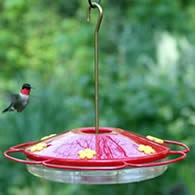
Red-Breasted Nuthatch Mating, Nesting, and Feeding Habits
While a permanent resident in its breeding range, the Red-breasted Nuthatch sometimes migrates south during periods of a short food supply of conifer seeds.
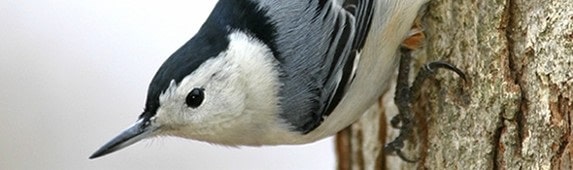
You'll often see this bird upside down on the side of a tree trunk, gleaning insects from bark crevices.
Description
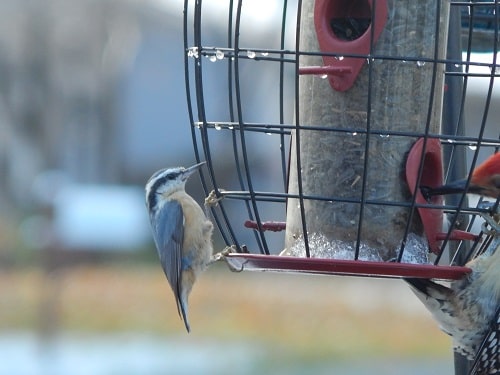
Male Red-breasted Nuthatch
The Red-breasted Nuthatch measures about 4 1/2 to 5 1/2 inches in length. With a black cap, black eyeline, and white eyebrow.
A stocky, small bird, with a short tail. Blue-gray back with rusty underparts.
The female and young have duller head markings and lighter underparts.
Mating Habits
Considered monogamous, these birds carry out their courtship displays at the top of trees.
Males can be heard singing their courtship song in early morning, also from the top of trees.
Nesting Habits Red-breasted Nuthatch
Beginning in late April early May, the Nuthatch pair begins excavating a cavity nest in a dead tree.
The nest site can be anywhere from 5 to 100 feet above ground. Although 15 feet above ground is about average. Sometimes uses bird houses.
Inside the cavity, bark strips, grass and plant fibers are placed at the bottom for nesting materials.
| Red-breasted Nuthatch Nesting Stats | |
|---|---|
| Eggs | 4 - 7 |
| Incubation | 12 - 13 days |
| Nestling Phase | 18- 21 days |
| Broods | 1 |
An interesting note about these birds is their habit of placing droplets of resin, or pitch, from balsam fir, or pine trees to smear around the entrance hole of the nesting site.
This practice continues throughout the nesting phase, resulting in an area sometimes 2 inches or more smeared with the sticky substance.
The reason for doing this is really unknown.
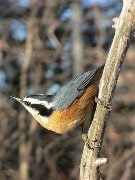
Nuthatch
Speculation is to keep ants and small mammals from entering since they have to walk or crawl through the pitch.
The Nuthatches themselves are able to fly straight into the hole without being affected by the pitch.
The female lays 4 - 7 eggs that are white and finely spotted with brown. Incubation last about 12 - 13 days. Sources differ on whether the female or both male and female incubate.
The young leave the nest 18 - 21 days after hatching. Some young are independent within 2 weeks, others may stay for the winter.
Feeding Habits/What They Eat
Their diet consists of conifer seeds and insects. Watching them at the bird feeder you can see them take a single sunflower seed, fly away to a branch, and eat it before returning for another.
Another must have is a suet feeder. All the nuthatches will come to a suet feeder.
|

|

|

|
| Birds and Blooms | Pioneer Woman | People Magazine | First For Women |
wild-bird-watching.com participates in Amazon.com associates program. As such, we earn commisions from qualifying sales at no additional cost to you. See our Privacy Policy Here
Shop Great Products That Attract Nuthatches