Tufted Titmouse Nesting, Feeding, and Mating Habits Explored
The Tufted Titmouse is one of my favorite feeder birds. He has a perky way about him without being rash or a bully at the feeder.
If you spend some time outside where they see you often, they'll become more tolerant of you being around.
Since I feed year around and spend time in the garden, the ones that visit me have grown familiar with me. If I had the patience, I could probably hand-feed them.
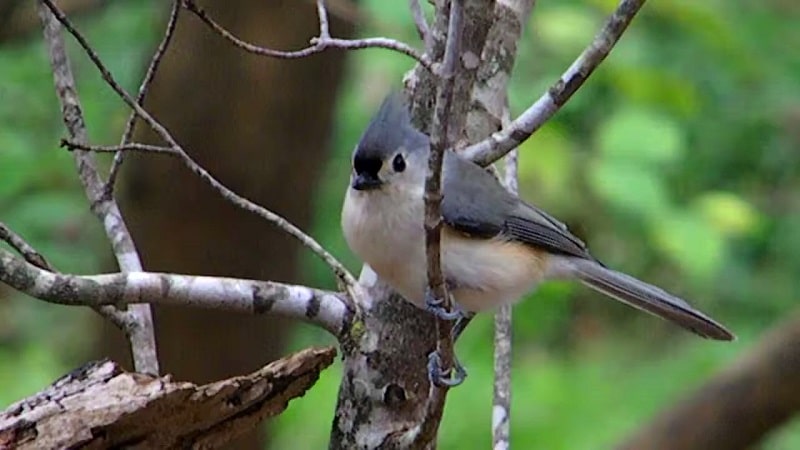
Titmouse on Branch
The range of the Tufted Titmouse extends down the Atlantic coast from middle New England and as far south as southern Florida.
Titmice are found along the Gulf coast to eastern Texas, where its range turns north and follows the eastern margin of the Great Plains as far as southeastern Minnesota and southwestern Wisconsin.
The northern boundary extends eastward through Michigan, southern Ontario, and northern New York to New England.
Listen - Tufted Titmouse Call
Description
The Tufted Titmouse bird measure 6 to 6 1/2 inches long. Noticeable large black eyes and a crest the bird can raise and lower.
The back and wings are gray. Their underparts are whitish, the flanks are buff and the forehead is black on the eastern birds. On Texas birds, the crest is black.
Both sexes are similar in appearance. Young after fledging have a yellowish-brown forehead and sand-colored eye-ring.
Mating and Courtship Habits
As a permanent resident in its range, titmice travel in flocks during the non-mating season.
With the lengthening days of spring, Tufted Titmice grow more intolerant of the wintering flock and become more aggressive towards each other.
As this happens, pairs (formed during the winter or anytime) disperse and begin looking for nesting sites.
Does the Tufted Titmouse Mate for Life?
Some pairs stay together for several seasons while others leave their mates for new territories.
Feeding Habits of Tufted Titmouse - What they Eat
Shy at the birdfeeder, letting more aggressive birds feed before getting food for themselves. This bird primarily eats seeds, although insects make up a portion of its diet.
Some of the seeds and fruit that are eaten include oak and beech mast, pine seeds, blueberry, blackberry, mulberry, bayberry, Virginia creeper, and hackberry.
Tufted-Titmice do not eat all the food they find at once. Instead, they hide it in tree bark or bury it in the ground. This behavior is called caching.
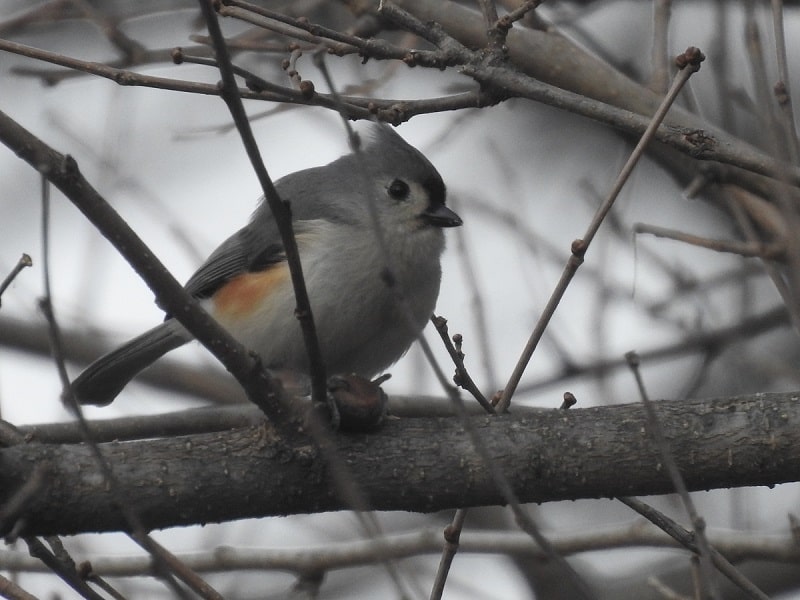
Tufted Titmouse With Seed
An interesting note is that the Tufted-timouse will cache one seed at a time and store it within 43 yards of the feeder.
They will locate these caches in various places to safeguard them from bird and mammal raiders.
A fun fact is that Downy Woodpeckers join flocks of Tufted-Titmice and Black-capped Chickadees because of the alarm call of these birds.
Chickadees and Titmice give an alarm call when they see any danger. The Downy can spend its time feeding instead of watching for hawks.
At the bird feeder, you can attract the Tufted Titmouse by supplying sunflower seeds in your Bird Feeders.
Like Black-capped Chickadees, these birds will pick one seed, fly to a perch, eat the seed, and return to the feeder for another seed.
Tufted-Titmouse Nesting Habits
Titmice prefer large patches of woodland as their nesting territory. Although they prefer a natural cavity, they will use a properly placed birdhouse.
Preferring to nest fairly high in trees. Titmice do not excavate their own nest site instead, look for old woodpecker holes or broken limbs.
Abandoned Downy, Hairy, and Red-bellied Woodpecker cavities are prefered for nest sites.
| Tufted Titmouse Nesting Stats | |
|---|---|
| Eggs | 5 - 8 |
| Incubation | 14 days |
| Nestling Phase | 18 days |
| Broods | 1 - 2 |
Titmice will not use the same nesting site for more than a single season. The nest can be located up to 90 feet above the ground.
Tufted-Titmouse build a cup-shaped nest of moss, bark strips, and hair, placed at the bottom of a tree cavity.
Females will lay 5 to 8 eggs that are white with brown specks. Incubation is done by the female only and last 14 days.
During incubation, the male sometimes feeds the female. Females will leave the nest from time to time to feed and bathe.
The young will leave the nest in about 18 days after hatching.
1 - 2 broods raised each season.
Eating Seeds From Tree

|

|

|

|
| Birds and Blooms | Pioneer Woman | People Magazine | First For Women |