Exporing the Rose-breasted Grosbeak Mating, Nesting, and Feeding Habits
The Rose-breasted Grosbeak is often considered one of the prettiest birds to arrive in late spring with its Robin-like song being sung from the treetops.
Many bird watchers claim this bird was their favorite after seeing it for the first time.
Its treetop song is the beginning of claiming territories, attracting a mate, and raising another nest of young in a new season.
Description
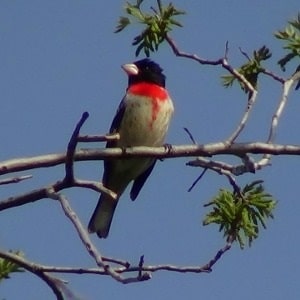
Male Rose-breasted
The male Rose-breasted Grosbeak is a real showstopper with his striking black and white plumage, accented by a vibrant rose-red patch on his chest.
His wings and back are black, and his belly is white. He also has a thick, conical bill that he uses to crack open seeds and insects.
The female Rose-breasted Grosbeak is a bit more understated, with a streaked brown and white appearance.
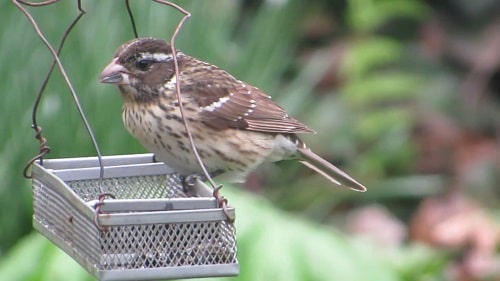
Female Rose-breasted Grosbeak
Her head and back are brown, and she has white wing bars and a prominent white eye stripe. She is sometimes mistaken for a large sparrow.
Mating/Courtship
These birds are seasonally monogamous. (one male to one female) for a single breeding season. The breeding season runs from May to July.
Males arrive first and begin claiming territories. Within a few days of the male,s arrival, the females will show up.
Males will try to attract a female by his song. Sometimes a courtship dance is offered by the male for the female.
The dance consists of tipping the head back and holding his tail in an upright position and spread out. He then wags his head and body.
The female will decide whether breed with a specific male.
Rose-breasted Grosbeak Nesting Habits
Both males and females build the nest, with the female primarily responsible for most of the work.
The nest is a loose, open cup made of twigs, grass, and leaves, lined with finer materials like rootlets and hair.
The nest is located in a tree 5 to 25 feet above the ground. Rose-breasted Grosbeaks prefer saplings, shrubs, and vines as nesting sites.
The female lays 3 to 5 pale blue or green eggs with brown speckles.
Incubation last 13 to 14 days. Both males and females incubate the eggs. Eggs are rarely unattended.
| Rose-breasted Grosbeak Nesting Stats | |
|---|---|
| Eggs | 3 - 5 |
| Incubation | 13 - 14 days |
| Nestling Phase | 9- 12 days |
| Broods | 1 |
Young fledge in 9 to 12 days after hatching. Both adult birds feed the young. Typically, only 1 brood is raised each season.
Feeding Habits
In the wild, Rose-breasted Grosbeaks glean food from tree foliage. Insects, seeds, tree buds, and fruit are eaten.
During the breeding season, they consume more insects to meet their increased protein requirements.
Spring is the time to feed these birds. At your feeders, offer Safflower or Black-oil sunflower seed.
Singing
Predators
Predators at the nest site include Blue Jays, Grackles, snakes, and raccoons.
Adult Rose-breasted Grosbeaks will mob Blue Jays and Grackles that enter their nesting territory.
Predators of adults include Sharp-shinned and Cooper's Hawks.
Learn More About The Different Types of Grosbeaks

|

|

|

|
| Birds and Blooms | Pioneer Woman | People Magazine | First For Women |