Red-bellied Woodpecker Explore the Mating, Nesting, Feeding Habits
The drumming in early spring signals that the male Red-bellied Woodpecker is claiming territory and hopes to court a mate for a season of nesting and raising young.
Description
Novice birders may confuse the Red-bellied with the Red-headed Woodpecker, but their differences are striking.
The male Red-bellied measures about 9 inches with a wingspread of about 17 inches. He has bands of black and white on his back referred to as a "ladder back."
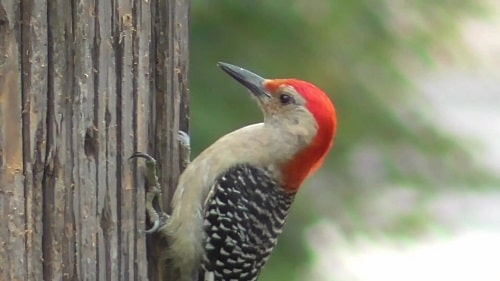
Male
You can easily identify him by his vibrant red forehead, crown, and nape. The breast and face are a dull gray.
The difference between the female Red-bellied Woodpecker and the male is the amount of red on each.
The female is similar to the male but has red only on the nape and above the bill. Her crown is gray.
The Red-bellied Woodpecker is named for a small quarter-sized patch of reddish tint on the belly, sometimes difficult to see but easier if you watch them at your feeders.
Juveniles don't have any red on their heads, and their markings are less contrasting, giving them a grayer appearance compared to the grown-ups.
You'll notice that their bills are a browner shade.
While the Red-bellied is not a rare Woodpecker, habitat destruction and competition with non-native species like European Starlings reduces populations.
Mating and Breeding Courtship Habits
Similar to all woodpeckers, the Red-bellied uses drumming as the primary source for attracting and communicating with potential mates.
This habit of drumming may be done on hollow limbs, gutters, siding, utility poles, or any other material that it finds resonates well for its needs.
Much to the dismay of the person who wishes to "sleep in" on weekends or the night shift worker.
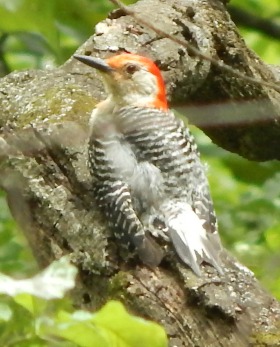
Picture of Female Red-bellied Woodpecker
Do Red-bellied Woodpeckers Mate for Life?
Considered monogamous throughout the breeding season. Some may form pair bonds lasting over several seasons, but they are not considered as mating for life.
An unusual part of courtship with this woodpecker species is mutual tapping.
Generally done at a potential nesting cavity, one bird will enter as the other stays outside and each will take turns tapping to the other.
Breeding activity occurs at the time of pair formation, which is as early as January-February. Eggs are laid in late April in most areas.
In Southern states such as Alabama and Texas as late as July.
Feeding on Suet
Most late nests seen in northern states are most likely re-nesting attempts due to the failure of the first nest. Florida has had egg laying as late as August.
Red-bellied Woodpecker Nesting Habits
Both males and females will build their nest in a tree, (dead or decaying) a utility pole, or take over another species of woodpecker home.
Red-bellied Woodpeckers will also nest in man-made birdhouses
Each season, a new cavity is excavated but may be in the same tree. Not unusual to see 3 or 4 cavities on a single limb in a row.
The imported European Starling usurps the nesting cavities of Red-bellied Woodpeckers.
Studies have shown that 50 percent of nest cavities are taken by Starlings, which reduces the clutch sizes of the woodpeckers.
The female Red-bellied Woodpecker will lay 4 - 5 pure white eggs. One egg is laid each day until the clutch is complete.
Incubation (gestation period - not the correct term for birds) is done by both males and females after the last egg is laid and will last about 12 - 14 days.
The baby birds will fly from the nest (fledge) in about 24 - 27 days after hatching.
| Red-bellied Woodpecker Nesting Stats | |
|---|---|
| Eggs | 4 - 5 |
| Incubation | 12 - 14 days |
| Nestling Phase | 24 - 27 days |
| Broods | 1 - 2 |
The adults divide the young between them and the young continue to depend on and follow the adults for 5 to 6 weeks.
After this post-fledging training, the male will drive the young from the territory.
In the north, a single brood may be raised each season while in the south two and even (rarely) three broods may be raised.
Red-bellied Woodpecker Call
Feeding Habits - Diet What they Eat
Red-bellied Woodpeckers are not rare and will readily visit winter bird feeders if suet is offered.
In Spring, a fruit feeder with orange halves will bring them closeup.
These Woodpeckers cache food in bark crevices, vine rootlets, and other places that require no excavation.
While they do store food, they don't do it at the level of most other woodpeckers. They're able to find food year-round.
Other items that can be offered at the home feeding station are peanut butter, sunflower seed, and cracked corn.
In the wild, Red-bellied Woodpeckers eat a diet of mainly vegetable matter consisting of a variety of tree nuts such as beechnuts, hickory nuts, and acorns.
Other foods include seeds, beetles, insect larvae, tree frogs, and fruit.
They are also known for eating the eggs and young of other birds, whether in open cup nests or nests in tree cavities.
Are Red-bellied Woodpeckers Rare
East of the Rockies, the Red-bellied Woodpecker is widespread and fairly common in backyards with older trees.
In southern states, this woodpecker has been around for a long time and has been expanding northward and into the central plains.
Do Red-bellied Woodpeckers Migrate?
Red-bellied Woodpeckers are considered permanent residents in most areas. There are some southward movements from those that breed in the northernmost areas.
These woodpeckers are sensitive to cold weather extremes. However, warmer temperatures are believed to contribute to its northern expansion.
Predators
Predators that attack eggs and nestlings are rat snakes, Pileated Woodpeckers, Starlings, Red-headed Woodpeckers, and flying squirrels (southern).
Adults and fledglings have Coopers Hawk, Sharp-shinned Hawk, Rat snakes, and Starlings as predators.
Attract More Woodpeckers With These Great Products

|

|

|

|
| Birds and Blooms | Pioneer Woman | People Magazine | First For Women |