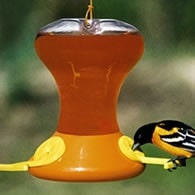
Why Do Birds Sing? - Are They Just Happy?
Ever wonder why birds sing, especially in the morning? Or, how they can create such beautiful sounds? Read on to discover how and why.
One reason we feed wild birds around our homes is that we presume they appreciate a little help from their friends.
Another reason is that we simply enjoy having them around. We like watching their antics, seeing their colors -- and listening to them.
Listen to Bird Sounds in Nature
Each bird species is capable of making a variety of sounds that it uses to communicate with other birds.
These sounds are songs, which usually are long and complex, and calls, which usually are short and simple.
By encouraging birds to our yards, we are more liable to hear all their vocalizations.
Songbirds account for nearly half of the world's 9,600 different species and about 40% of the 750 found in North America.
For the most part, it is the males that "sing" -- a consistently repeated pattern of tones.
Learn The Sounds of Birds in Your Area
Stokes Bird Songs: Eastern Region
Stokes Bird Songs: Western Region
Check Them Out Today
But in a few species, including Northern cardinals, Baltimore orioles, and rose-breasted grosbeaks, the female also occasionally breaks into song.
Birds generally sing more in the early morning and late afternoon.
Birds Sing Mornings and Afternoons
The reasons for morning and late afternoon singing can be several reasons. The times offer less ambient noise so their songs can be heard long distances.
This allows potential mates to hear the songster and make a determination about its fitness. If she likes the sound, she'll come closer.
The song can also be heard by potential rivals and put them on notice that a specific territory has been claimed.
Lastly, it's a way to communicate with mates and let them know where they are.
At night, males may roost away from nest sites while females will be incubating eggs or brooding young.
While singing behavior varies among species, most singing takes place during the breeding season. Lags occur during the short mating period and when the young are being cared for.
Bird singing pretty much stops when the nestling period is over. At least in the North, winter ends singing -- except for Northern Cardinals. They seem to sing year-round.
The songs of birds are learned, not inherited, much as with humans.
Within a couple of months, fledglings will have developed a "subsong" that matures into an adult primary song in perhaps a year.
Male Cardinal Call
If a white-crowned sparrow grew up with, for example, only song sparrows around, it would learn song-sparrow songs.
Although chipping sparrows have only one basic song, song sparrows may have 10.
Some wrens have more than 100, and -- as many of you well know -- mockingbirds have a couple hundred that they voice endlessly sometimes all night long.
How Birds Make Sounds
The species that sing create musical sounds by their syrinx. This is a kind of double voice box at the bottom of the windpipe.
Two sets of membranes and muscles where the windpipe branches into the lungs vibrate at high frequencies as air is exhaled.
While singing, a bird can alternate exhaling between its two lungs and thereby sing in harmony with itself.
Usually, a male that is defending a territory or attracting a mate will sing from one of the highest or most conspicuous spots available.
This favorite spot may be used time and time again. On the other hand, some birds, such as larks, bobolinks, and buntings, sing while flying.
And while birds usually do not sing around their nests, a few sing a quiet "whisper song" that can be heard for only a few yards.
In the final analysis, different birds sing different songs but usually for much the same reasons. One of those might be that they are well-fed, stress-free, and happy.
© The Bird's-Eye reView - Used with permission