Red-tailed Hawk Mating, Nesting, Feeding and Breeding Habits
One of the most commonly seen, the Red-tailed Hawk can be found all across North America.
Preferring a variety of open habitats, this bird of prey can be seen holding still into the wind while hunting.
In some Native American cultures, the feathers of this bird are considered sacred and are used in religious ceremonies.
Interestingly to note, most hawks captured for falconry in the United States are Red-tails.
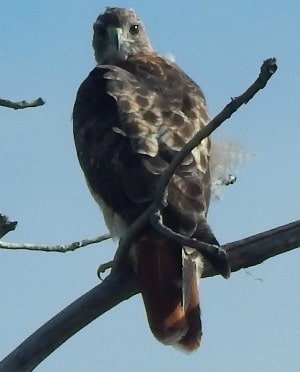
Red-tailed Hawk in Tree
Red-tailed Hawk Call
Scream: The most iconic call of the red-tailed hawk is its high-pitched scream, often portrayed in movies and TV shows to represent eagles or hawks.
This call is a series of descending, raspy screams that can carry over long distances.
It's often used for territorial communication and attracting mates.
Kee-eee-arr: This call is a bit more melodic than the scream.
It consists of a series of repeated notes, starting with a high "kee" followed by a descending "eee-arr."
This call is also used for territorial communication and is often heard during the breeding season.
Description, What Do They Look Like
A large bird, the Red-tailed Hawk, measures 19 to 26 inches in length with a wingspan of 4 1/2 feet. The female is up to a third larger than the male.
The plumage of these birds varies depending on the region in which it resides.
Typically, the adult bird is a dark brown above with a white breast and a band across the belly.
The tail is brick red on the upper side.
Immature Red-tails are similar in appearance, except the tail is brown, turning reddish the following spring.
Mating Breeding, When Do They Have Babies? Habits.
The mating and breeding habits of these birds begin at about three years of age and include aerial displays meant to advertise their readiness for breeding.
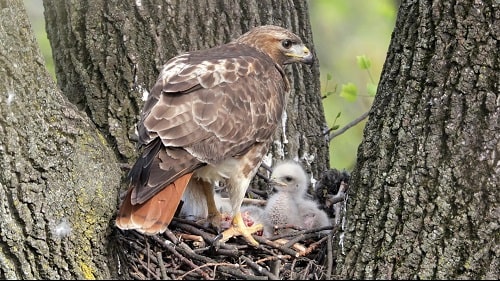
Young at Nest
The Red-tailed hawk's courtship begins in late winter to early spring. During this time, the male red-tailed hawk will perform a courtship display to attract a female mate.
The male will fly high in the air and then dive rapidly, often spiraling and performing other acrobatic maneuvers to impress the female.
The male will also bring the female gifts of food, such as small mammals or birds, to further court her.
Once a pair has formed, they will engage in mutual preening and vocalizations to strengthen their bond.
Eventually, they will mate, which typically involves the male climbing on top of the female and briefly copulating.
The breeding season of these Red-tailed hawks begins between March and April.
Do Red-tailed Hawks Mate for Life
Red-tailed hawks are monogamous birds, remaining with the same mate throughout the breeding season, often mating for life.
Male and female will stay in the same nesting territory every year, even using the same nest.
In the event one dies, the remaining one will quickly seek out a new mate.
Nesting Season Habits
The Red-tailed hawk nest is built by both males and females.
The hawk nest is a platform constructed of sticks and twigs, lined with bark and greenery.
Nest-building season may begin in February with established pairs from previous seasons, with the first egg being laid by mid-March.
Old nests are reused with some refurbishing by adding sticks and greenery.
The nest is located in a tree 15 to 120 feet above the ground. Sometimes nests are built on cliffs.
The female Red-tailed hawk begins laying eggs in mid-March.
She lays one egg every other day until a clutch of 1 to 4 bluish-white eggs with dark marks is complete. Most commonly lays 2 to 3 eggs.
Incubation begins after the first egg is laid. The eggs hatch over several days.
The male and female share incubation duties with the female incubating longer times. The eggs hatch after 28 days of incubation.
The young will leave the nest in 44 to 46 days after hatching.
| Red-tailed Hawk Nesting Stats | |
|---|---|
| Eggs | 1 - 4 / 2 - 3 most common |
| Incubation | 28 days |
| Nestling Phase | 44 - 46 days |
| Broods | 1 |
Red-tailed hawks raise only one brood in a season. They may re-nest if the first nesting attempt is unsuccessful.
Red-tailed Hawks are very territorial towards others of their species. Sometimes locking talons in flight with intruders.
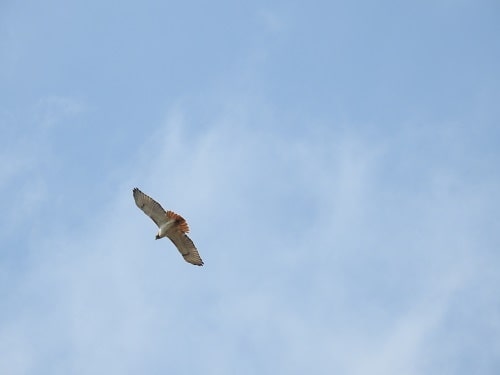
Red-tailed Hawk in flight reddish tail in Clear View
Feeding Habits
In the nest, the male feeds both the female and the young. Occasionally, the female may make short hunting trips.
Highly valued by farmers, the Red-tailed Hawk may perch, hover, or hold still into the wind when hunting.
While they eat mice, birds, large insects, reptiles, and other small mammals, it's rats, voles, and hares that make up the bulk of their diet
Most of their hunting (60 - 80 percent) is done while perched. The eyesight of a Red-tailed Hawk is about eight times stronger than humans.
Red-tail Hawk Feeding in Tree
Migration Red-tailed Hawk
Only the northern populations of the Red-tailed Hawk (Alaska, Canada, northern United States) migrate south in winter. Others are non-migratory.
Lifespan
The Red-tailed Hawks average lifespan in the wild ranges from 13 to 20 years. In captivity, lifespans are usually longer.
What to Do When You Find Hawks At Your Feeders
Learn the Habits of the Cooper's Hawk
Frequently Asked
Are Red-tailed Hawks Rare?
Probably the most common of the raptors, Red-tails have expanded into Eastern North America and the Northern Great Plains.
The reason for this expansion is likely due to the increased clearing for agriculture.
Can They Pick Up A Dog or Cat?
At the high end, a Red-tail hawk may be able to lift at most, 5 pounds. So a dog or cat weighing more would be too much.
However, keep in mind, if your dog or cat gets too close to a nest site, it may be attacked.
Predators of Red-tailed Hawks
Predators include Humans, Great Horned Owls, Crows, and Ravens.
Raccoons and snakes will eat the eggs and young of hawks.

|

|

|

|
| Birds and Blooms | Pioneer Woman | People Magazine | First For Women |