The Northern Mockingbird What they Eat, When they Nest Habits
In spring, the Northern Mockingbird may sing all night long. This bird will often fool even a well-seasoned birdwatcher.
Singing the songs of other bird species, the bird watcher has to listen closely to distinguish who is doing the singing.
One unique habit of Mockingbirds is their defense of two separate territories. One is the breeding territory, which is typical for most birds.
The other is their fall and winter feeding territory. Both are about 1 to 2 acres in size, although the feeding territory is generally smaller.
Related to the catbird and thrasher, the name means "mimic of many tongues".
This bird is able to imitate more than 30 bird songs in succession.
Other sounds such as squeaky hinges, barking dogs, and chirping crickets are also imitated.
Northern Mockingbird Call
The mockingbird's song is a melodious medley of various sounds, imitations, and original compositions.
It is typically a long, complex sequence of phrases, each repeated several times before transitioning to a new phrase.
These birds have been known to imitate the songs of other birds, mimic sounds of animals, and incorporate elements of human-made noises such as car alarms and sirens.
They can even imitate the calls of other bird species in their vicinity.
Description What Do Mockingbirds Look Like
Mockingbirds measure about 9 to 11 inches in length. Slender with a long tail. Gray above and whitish below. Males and females look alike but sometimes males will be larger.
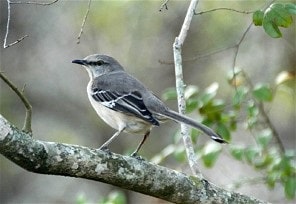
Northern Mockingbird
A slender bird with a longer bill that is slightly curved.
The outer feathers of the tail are white. Two wing bars on top of each wing and a large white patch under each wing are visible in flight.
Mating, Courtship Habits
Males generally establish a nesting territory as early as February onward.
Unmated females remain longer on their wintering territory, while some pairs may stay together during winter, sharing territory.
The primary nesting and egg laying season is between April and July, although it can extend a month on either side.
As soon as a female enters an unmated male's territory, the male challenges her with harsh "chacks".
The two birds square off and watch each other. The male pursues the female, and if she leaves, he may try to entice her back with spread wings and soft calls.
The female will eventually select a mate or reunite with a male from the previous season.
Once a pair bond is established, the songs are shortened and more subdued.
Sitting together quietly, both mockingbirds make a "hew-hew" call to keep in contact.
Northern Mockingbirds are strongly monogamous. If a male fails to find a mate, he will sing loudly until late in the season.
If no mate is found, he will abandon his territory. Mockingbirds do not mate for life.
Nesting Habits
Mockingbird Singing Multiple Calls
Mockingbirds typically nest in shrubs, trees, or dense vegetation.
They are known for building their nests in a variety of locations, including gardens, parks, wooded areas, and suburban neighborhoods.
They are adaptable birds and can nest in both rural and urban environments.
These birds often choose locations that provide good cover and protection for their nests, such as thorny bushes or dense foliage, which helps conceal their nests from predators.
The nest construction of the Northern Mockingbird is done by both the male and female.
Although the male does most of the work, which is less common in other birds.
The nest is built within 2 or 3 days. Five or six nests may be built during the annual breeding period. Most will not have eggs.
The nest is a bulky structure of twigs upon which a compact mass of leaves, grasses, moss, hair, or artificial fibers is placed.
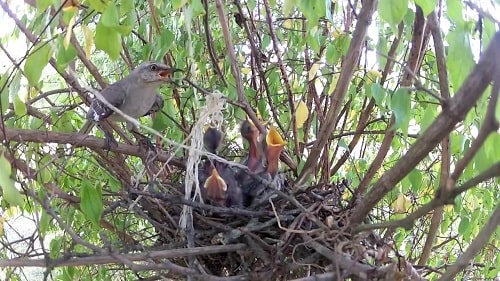
Nestling Mockingbirds
The interior cup is lined with fine, soft rootlets, wool, or bits of string. Located about 3 to 10 feet above the ground.
The female lays 3 to 5 pale blue or green eggs that are blotched with a russet or cinnamon color shown in image below.

Mockingbird Eggs
She will begin constant incubation when the second to last egg is laid. Incubation (gestation period is not the term for birds) will last about 11 to 13 days.
Both parents provide food to the hatchlings for about 12 days. The entire procedure of incubation and fledging approximates 23 to 25 days.
| Mockingbird Nesting Stats | |
|---|---|
| Eggs | 3 - 5 |
| Incubation | 11 - 13 days |
| Nestling Phase | 12 days |
| Broods | 2 - 3 |
Nests are rarely reused. New nests are sometimes built on top of an old nest. The second nest is begun shortly after the first brood fledges.
Mockingbirds will abandon eggs during incubation if the nest is disturbed, but rarely will they abandon their young.
Mockingbirds aggressively defend the nest site against any predator including cats, dogs, and humans.
Not uncommon to nest multiple times during the season. Typically, the season for nesting ends in August
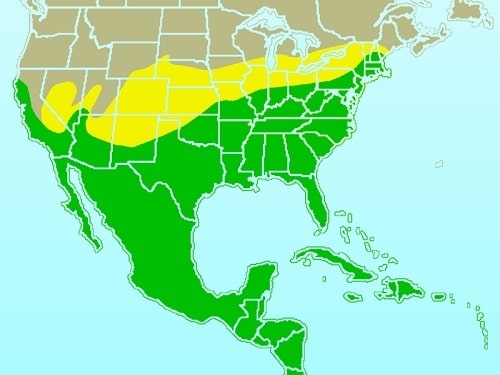
Range Map
Feeding Habits - What They Eat
Mockingbirds feed on fruits and berries of holly, smilax, woodbine, sumac, and other plants.
Some garden and horticultural crops, such as grapes, blackberries, and figs, are also favorites of this bird.
In addition to fruits, this bird also eats harmful weevils, cucumber beetles, chinch bugs, and grasshoppers.
So while many think this bird is detrimental to fruit crops, the truth is, it is an important bird in an agricultural sense.
Northern Mockingbirds will defend their feeding-winter territories against other birds such as Robins, Starlings, and woodpeckers, who also compete for fruits.
See Also: Birds Singing At Night

|

|

|

|
| Birds and Blooms | Pioneer Woman | People Magazine | First For Women |