Brown Thrasher Mating, Nesting, and Feeding Habits Explored
Spring is the time you'll most likely see the Brown Thrasher. Not so much because of this bird's migratory patterns. Instead, habitat is most likely the cause.
These wary birds prefer dense thickets and woodland edges.
These birds are partial migrants. Populations that nest and breed farther North will move slightly Southward to find food while southern populations are year-round residents.
What Brown Thrashers Look Like
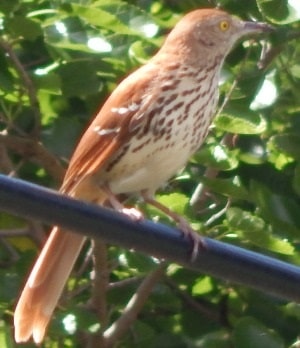
Brown Thrasher
Known for its striking reddish-brown plumage and melodious song, a Brown Thrasher is a medium-sized bird that is primarily brown in color with a long, curved bill.
It has a streaked breast and a reddish-brown tail that is often held upright. The wings are also reddish-brown with white and black markings.
The brown thrasher has a distinctive yellow eye and a white stripe above the eye. It measures about 11-12 inches in length and has a wingspan of about 13-14 inches.
Overall, they have a sleek and slender appearance with a slightly curved posture.
This is the only Thrasher East of the Rockies and covers the entire eastern part of the US.
How are Male and Female Brown Thrashers different?
While male and female Brown Thrashers are for the most part similar there are subtle differences.
In general, male brown thrashers tend to be slightly larger than females. Males typically measure around 9-11 inches (23-28 cm) in length, while females are slightly smaller, measuring around 8-10 inches (20-25 cm).
If one is singing it's easier to tell the difference. Male brown thrashers are known for their complex and melodious songs, which they use to defend their territory and attract mates.
Females also sing, but their songs are generally less elaborate and less frequently heard.
Unfortunatly, unless they are together long enough to see the size difference or song, it's difficult to tell which is male or female.
Mating Habits
Brown Thrashers are monogamous, meaning they form long-term pair bonds. Their breeding season typically occurs from April to July.
As spring begins, the male Brown Thrasher arrives first. Claiming territory and choosing perches from which to sing.
Within 10 days, the females arrive and the males will attempt to attract a female to his territory.
During courtship, the male Brown Thrasher will sing a series of complex, melodious songs to attract a female.
The courtship display of the male consists of him walking in circles around the female while dragging his tail along the ground.
The female may pick up sticks as a sign of her willingness to pair with the male.
Nest building begins as soon as the pair bond is formed.
Brown Thrasher Nesting Habits
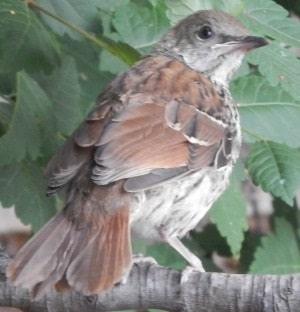
Fledgling Brown Thrasher Bird
Both male and female birds share in the nest-building process. The cup-shaped nest is constructed with an exterior of twigs, grass, and leaves.
It's common for these birds to nest in dense shrubs or low trees that often have thorns.
The inside of the nest is lined with fine grasses and rootlets. The nest is placed anywhere from the ground up to 15 feet in height.
Brown Thrashers are very aggressive at defending the nesting site.
An average clutch of 4 eggs is laid. Eggs are variable in shape and color, generally, they're a light blue with dark marks. Incubation is done by both males and females.
Incubation lasts 12 - 14 days. The young leave the nest in 9 to 12 days after hatching, which is quick for birds of this size.
The female will help feed the fledglings for just a few days, sometimes beginning a second nest.
| Brown Thrasher Nesting Stats | |
|---|---|
| Eggs | 3 - 5 |
| Incubation | 12 - 14 days |
| Nestling Phase | 9 - 12 days |
| Broods | 1 - 2 |
The male will continue tending to the young by himself if a second clutch is started.
Second nests are not common, but if unsuccessful with the first, second nesting attempts will happen.
Nests are reused from season to season, but they will remove the interior lining and replace it each time.
The nest won't be used a second time in the same season. Two broods each season may be attempted.
The Brown Thrasher Call Song
The Brown Thrasher is similar to a Mockingbird in that both birds can imitate various sounds.
Some birders consider the Thrasher as having a sweeter and fuller voice than Mockingbirds.
Best of all, Thrashers don't sing at night.
Brown Thrasher Mimicking Multiple Songs/Calls
What do Brown Thrasher Eat?
Brown Thrashers are omnivorous, feeding on a variety of insects, fruits, and seeds.
They primarily forage on the ground, using their long, curved bills to sweep through leaf litter and soil in search of insects and other invertebrates.
Tossing leaves to look for insects to eat is one of the ways it's thought to have gotten its name.
Their diet includes beetles, grasshoppers, caterpillars, spiders, snails, and earthworms, as well as berries, fruits, and seeds from plants like sumac, dogwood, and poison ivy.
Brown Thrashers may also occasionally feed on small vertebrates, such as lizards, frogs, and small snakes.
You can attract Brown Thrashers during the nesting season by providing Suet in a suet feeder
Predators of Brown Thrasher Birds
Predators include snakes and domestic cats. Eggs can be destroyed by Blue Jays and Catbirds. Brown Thrashers are aggressive towards intruders.
Known to use its strong bill to attack snakes, birds, cats, dogs, and even humans if it feels threatened or if the young are at risk.
Sometimes uses the broken wing display to lure intruders away.
What Does it Mean if You See a Brown Thrasher?
In some cultures and belief systems, birds are considered messengers or symbols of various things.
The brown thrasher, with its beautiful song and distinctive appearance, may be seen as a symbol of creativity, communication, or the importance of expressing oneself.
It could be a reminder to pay attention to your own voice and ideas.
A more natural meaning is that as partial migratory birds, their presence in a particular area can indicate the changing of seasons.
Seeing a brown thrasher may suggest that spring or fall is approaching, depending on your location. It can be a sign of the natural cycles and rhythms of the environment.
|

|

|

|
| Birds and Blooms | Pioneer Woman | People Magazine | First For Women |