Exploring the Nesting and Feeding Habits of Belted Kingfisher
Updated October 25, 2023
The Belted Kingfisher bird is extremely shy. Trying to photograph this bird takes a lot of patience and a good hiding spot.
Commonly found near rivers, streams, and lakes across North America. If you know where it perches, that might be the place to try to get a photo.
In this article, we will explore the mating, nesting, and feeding habits of the Belted Kingfisher.
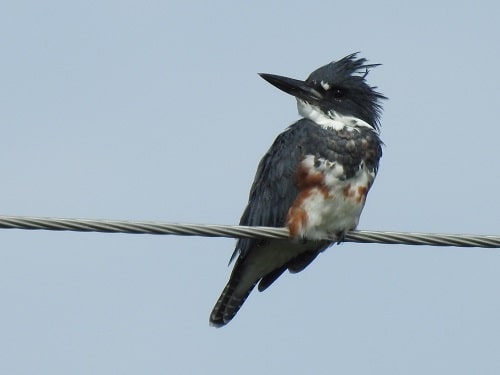
Female Belted Kingfisher With Two Bands
Kingfisher Appearance and Size
The size of this bird is 11 to 14 inches in long. A large blue bird with a long, thick black bill. Blue-gray above and on the head.
Noticeable crest on the head. A white spot in front of red-brown eyes.
The male has a blue-gray band across the breast. One of the very few species where adult females have more color than males.
The female has the same blue-gray band as the male but also displays an additional rust-colored band across her belly.
Belted Kingfisher Call
Once you've heard the Belted Kingfisher call, you'll remember it. A distinctive, loud, and rattling call.
Its song is not melodic like many other birds, but rather a series of harsh, mechanical sounds.
The most common call is a loud, penetrating rattle, often described as a "klee-klee-klee-klee" or "kleeer" sound.
This call is typically given in flight, during territorial disputes, or when the bird is alarmed.
These birds also have a variety of other calls, including a chatter, a whining call, and a sharp, high-pitched "zeep" sound.
These calls are often heard near bodies of water where the bird is hunting for fish.
Mating - Pair Bond Habits
Adult kingfishers are solitary birds for most of the year, but during the breeding season, they form monogamous pairs.
The breeding season for belted kingfishers is usually from early March to late July.
The male bird arrives at the breeding site first and establishes his feeding territory, which they defend aggressively against other males.
Once a female arrives, the male will court her with a series of displays and calls.
The male may also bring her fish or other prey items as gifts, which may help to strengthen the pair's bond.
Courtship Behavioral Habits
Once the pair bond has been established, the male and female will engage in a series of courtship displays.
These displays involve a series of aerial acrobatics, such as hovering and diving, that are intended to impress the female.
The male may also make a distinctive call during these displays, which is a harsh, rattling sound that can be heard from a considerable distance.
These displays are a critical component of the mating process, as they help to ensure that the pair bond is strong enough to lead to successful breeding.
Belted Kingfisher Nesting Habits
The Belted Kingfisher nesting habits take place near water: streams, rivers, and lakes. Typically it builds its nest into the earthen banks of these waterways.
They begin building their nest cavity by taking turns digging a tunnel into an earthen bank near their fishing territory.
Burrows are built near feeding territories and may be reused from the previous season, although not defended aggressively.
Multiple burrows may be excavated, but only one nest chamber will be used. Males may use another for roosting at night.
Digging out a tunnel with their long bills and pushing the dirt and debris out with their feet as they push forward.
The tunnel will be 3 to 7 feet long when completed, and the eggs will be laid in total darkness.
| Belted Kingfisher Nesting Stats | |
|---|---|
| Eggs | 5 - 8 |
| Incubation | 22 - 24 days |
| Nestling Phase | 27- 29 days |
| Broods | 1 |
The area of the nest site itself is about 10 - 12 inches in diameter and is domed. Both males and females will share in the incubation.
Like some other deep cavity nesting birds, the eggs of this bird are pure white. The average clutch size is 5 to 8 eggs.
Incubation will last for 24 days. The young will be born without feathers and be brooded by the female, while the male feeds the young and the female.
Once the chicks get feathers, both males and females will feed them.
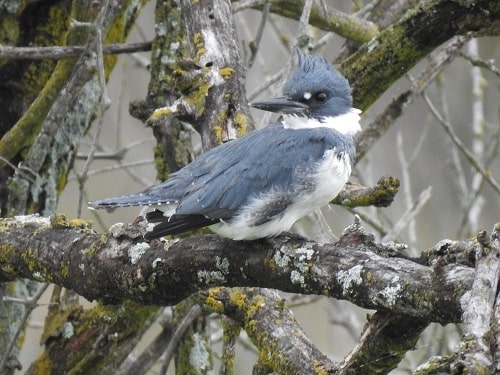
Male Belted Kingfisher One Band
The young will leave the nest about 27-29 days after hatching.
Within 1 - 2 weeks after leaving the nest, the young will be able to feed themselves and may find new territories or stay in familiar surroundings.
The adults will leave the nesting area but may remain in the overall territory, which can range in size from 1/2-mile to over 3 miles, depending on the shoreline.
Belted Kingfisher Feeding Diet Habits What They Eat
Often seen hovering over a body of water and then suddenly diving head first in pursuit of fish to eat.
Belted kingfishers are primarily piscivorous, meaning they are primarily fish eating birds.
They hunt by perching on a high branch or other structure overlooking the water and then diving headfirst into the water to catch fish.
They use their long bills to spear their prey, and they can catch fish up to 6 inches long.
Belted kingfishers also feed on other small animals such as frogs, crayfish, and insects.
An interesting behavior of the kingfisher is how it eats.

Belted Kingfisher in Flight photo: Andy Morffew
After diving for a fish, it will return to its perch and beat the food against the limb or whatever it's perched on.
Once done with slamming the food, it then tosses the fish up in the air, catches it in its long bill, and swallows it headfirst.
Like an owl, the Belted Kingfisher will regurgitate any indigestible parts in the form of pellets.
These birds teach their young to fish by dropping dead prey into the water for the young to retrieve.
What is the Belted Kingfisher Habitat?
The territorial and breeding habitat of Belted Kingfishers is wetlands, rivers, lakes, and ponds.
Their full range can be seen in the map below.

Belted Kingfisher Winter and Breeding Territory
Since they nest and make their homes in eroding banks, controlled streams may deprive them of nesting sites.
Breeding bird survey data shows an average population decline of almost 2 percent annually.
Only a partial migrate. In most of its range it is a permanent resident.